About Pagurus longicarpus Say, 1817
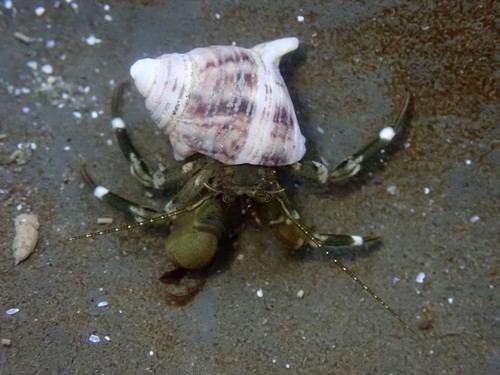
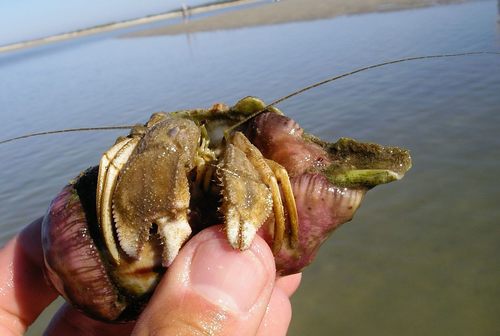
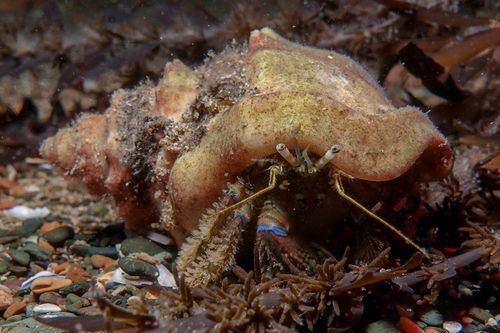
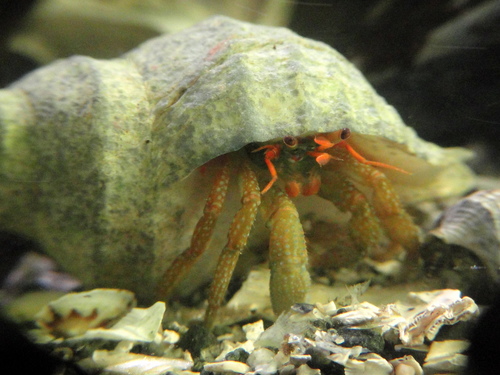
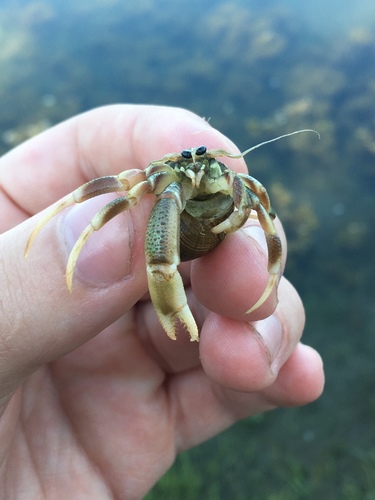
Pagurus longicarpus Say, 1817, commonly called the long-wristed hermit crab, is a species of hermit crab that reaches a maximum shell length of half an inch. Body coloration varies, but most individuals are gray, green, or white. Its right claw is much larger than the left, and each claw has a tan or gray stripe running down its middle. Like all hermit crabs, P. longicarpus cannot produce its own shells, so it scavenges empty gastropod shells to use for mobile shelter and protection of its soft abdomen. Common shells this species uses include those from periwinkles, snails, and oyster drills. Individuals anchor themselves inside shells by wrapping their abdomens around the internal columella, also called the axis, of the empty shell. Shell selection is crucially important for P. longicarpus: shells provide protection from predators, desiccation, and salinity stress, and shell availability also influences the species' competition, population size, and reproductive behaviors. This species is commonly found along the Atlantic coast of Canada and the United States, ranging from Nova Scotia to northeastern Florida, as well as along the United States Gulf coast all the way to Texas. In 2022, Neumann, Knebelsberger, Barco and Haslob reported that P. longicarpus has become established in the North Frisian Wadden Sea, a spread that likely happened due to trans-Atlantic transport of larvae in ship ballast water. In its native range, P. longicarpus lives in intertidal and subtidal Atlantic environments across a variety of substrates, at depths up to 200 meters. It is most often found in shallow tidal pools from April through October, and moves to deeper, warmer waters during fall and winter. Tidal pool habitats experience extreme fluctuations in temperature and salinity driven by tides and weather: temperatures and salinity rise rapidly on hot, sunny days, and drop rapidly on cool, rainy days, while rising tides adjust tidal pool conditions to match the surrounding ocean. These harsh variable conditions mean P. longicarpus relies heavily on its shell to cope with environmental change. These fluctuating conditions also affect the species' shell selection and shape its distribution across intertidal and subtidal regions. P. longicarpus has a breeding season that runs from late March to October, with peak breeding activity in April, and its main reproductive period falls during spring. Males compete with other males for access to females during the breeding season. Like many crustaceans, P. longicarpus performs precopulatory mate-guarding behavior: after a female releases a pheromone signaling she is sexually mature, the male grasps the female's shell. Males and females can be distinguished by the morphology of their pleopods: males have two pleopods, while females have three branching pleopods that their eggs attach to. Fertilization is internal and sexual, and both individuals must leave their shells to mate. After fertilization, the female keeps the eggs inside her shell while they grow and develop. Larvae are eventually released into the open ocean, where they go through three planktonic growth stages before becoming mature adults: the first zoea, then megalops, then the juvenile stage, before reaching adulthood.