About Pagurus hemphilli (J.E.Benedict, 1892)
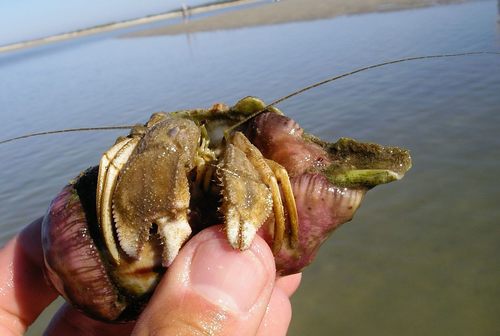
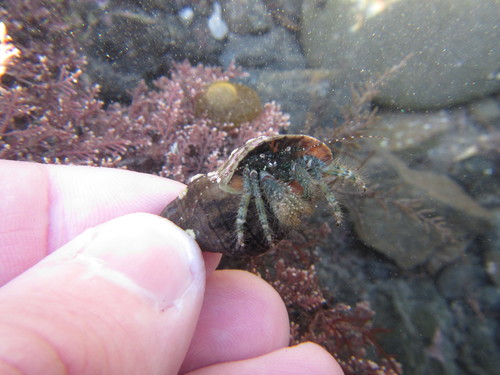
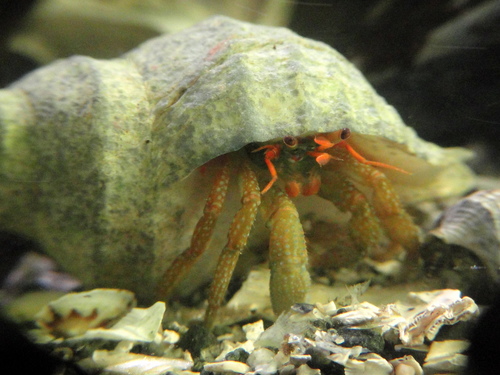
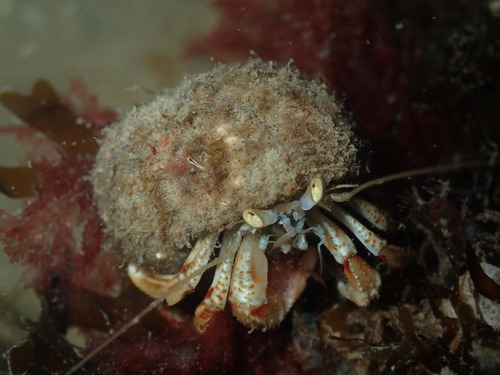
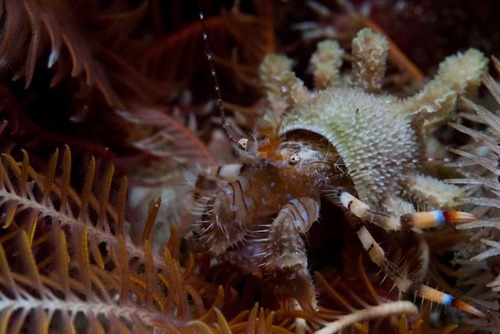
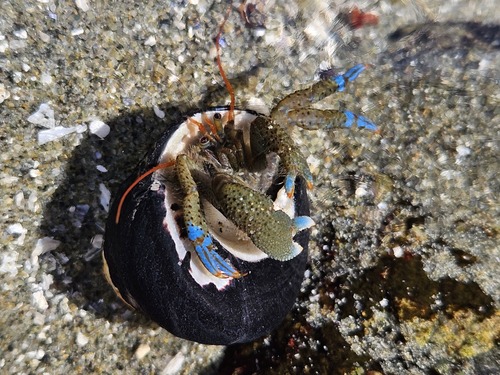
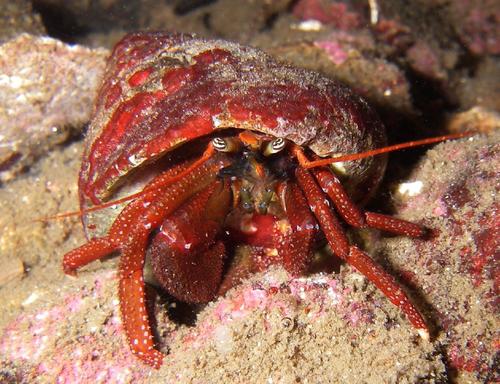
Pagurus hemphilli is a species of hermit crab first described by J. E. Benedict in 1892. This hermit crab is a rich maroon color marked with small blue dots, with yellow-tipped dactyls, gold-ringed corneae, and red to orange-red antennae that have no spots or rings. Juveniles sometimes have white bands on their ambulatory legs. Its two chelipeds, or claws, differ dramatically in size: the major cheliped is much larger than the minor cheliped. The entire body is almost completely hairless, and it has a smooth, shiny shield. It has a distinct rostrum that extends well past the lateral frontal lobes of the carapace. The palms of the chelae are rough with visible bumps. Its uropods are asymmetrical, and the carapace can grow up to 15 millimeters, or 0.6 inches, long. It looks similar to its congener Pagurus granosimanus, as both are dark-colored with light dots. However, P. hemphilli is distinctly more maroon, while P. granosimanus is olive-toned. P. hemphilli can also be distinguished from P. granosimanus by its comparatively longer outer carapace, even in the juvenile stage. The legs of the two species also differ: P. hemphilli has dark red legs with tiny yellow to blue spots and a white dot at the tip, while P. granosimanus has olive legs with light blue spots. Pagurus hemphilli occurs along the North American Pacific coast, ranging from Alaska to the Central Coast of California. It is more common towards the southern end of its range in Central California. This hermit crab lives on rocks in shallow water. It mostly occupies the upper subtidal region down to a depth of 50 meters, or 160 feet, but can also be found in low intertidal pools. Compared to its congeners Pagurus samuelis, Pagurus granosimanus, and Pagurus hirsutiusculus, P. hemphilli occupies a deeper shore zone. It has a lower tolerance for warm water, and experiences increased mortality at high water temperatures; a 50% mortality rate has been reported at 30.1 °C, or 86.2 °F. In the wild, it prefers waters that do not exceed 20 °C, or 68 °F. Most often, P. hemphilli lives in shells from Tegula species (such as Tegula brunnea), Lithopoma species, and Astraea species. To gain a better shell, P. hemphilli takes part in shell fights, where the loser gives up their shell. These fights can occur between members of this species, or between P. hemphilli and other Pagurus species. Larger hermit crabs have an advantage in these fights. The shells inhabited by this species are often heavily encrusted with coralline algae, and host other hitchhiking organisms such as the slipper snail Crepidula adunca and the limpet Acmaea mitra. An undescribed commensal amphipod species in the genus Liljeborgia has been observed living inside the occupied shell with P. hemphilli.