About Paguma larvata (C.E.H.Smith, 1827)
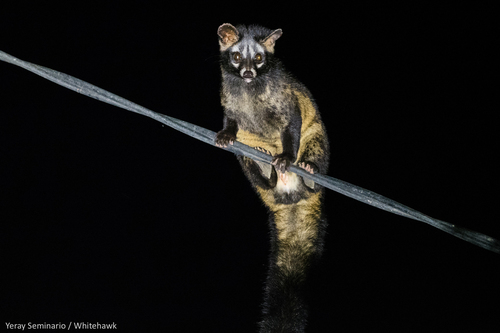
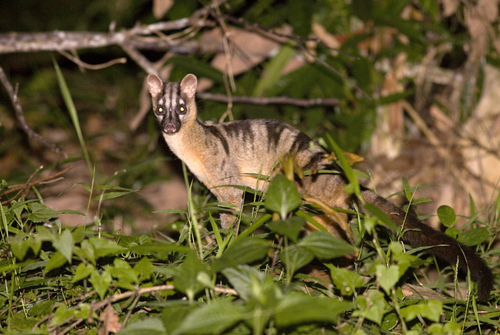
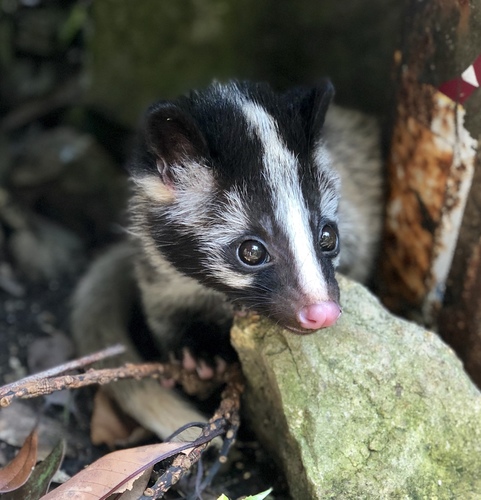
Characteristics of the masked palm civet (Paguma larvata) include fur that ranges from grayish to ochraceous. Its head, shoulders and neck are black, while its tail and feet are blackish brown. It has a white blaze on the forehead; white markings above and below the eyes extend to the ears, forming a half-collar. Morphologically it resembles other palm civets, but has no spots or stripes. Its tail is more than two-thirds the combined length of its head and body, and it has two pairs of mammae. The whitish mask extends laterally to the far edges of the cheeks, and caudally up the forehead, past the ears, and down the back of the neck before stopping just under the shoulder blades. The eyes are surrounded by white fur that can range from faint, incomplete outlines to well-defined blotches. The lips, chin, and throat are white. In some individuals, white fur stripes curve upward from the throat, similar in shape and location to human sideburns. These curved stripes vary in thickness, and their ends terminate either in small blotches at the ear base, or large blotches that surround the base of both darkly furred ears. Because this species has a large geographic range, differences in morphological traits can be observed across different populations. Adult masked palm civets usually have a head-and-body length of 50 to 60 cm (20 to 24 in), a tail length of 40 to 50 cm (16 to 20 in), and a body weight between 3 and 5 kg (6.6 and 11.0 lb), though some adult individuals can be lighter or heavier. Distribution and habitat The masked palm civet ranges from the northern parts of the Indian subcontinent, especially the Himalayas, eastwards across Bhutan, Bangladesh, Myanmar, Thailand, Peninsular Malaysia, Laos, Cambodia, and Vietnam to China, Borneo, Sumatra, Taiwan, and the Andaman and Nicobar islands. It has been recorded in evergreen forest, deciduous forest, and disturbed habitat. It also lives in fragmented forest habitats, although at lower population density. Genetic study results indicate that the masked palm civet is not native to Japan, and was introduced there multiple times over centuries; at least two of these introductions came from Taiwan. Ecology and behaviour The masked palm civet is a nocturnal, solitary predator that is occasionally active during the day. It is partly arboreal. When alarmed, it sprays a secretion from its anal gland to deter predators. Reproduction Masked palm civets are polyestrous and have promiscuous mating behavior. There are two breeding seasons per year. A female can give birth to up to four young. Captive masked palm civets are known to reach 15 years of age. Copulation in this species can last for more than 30 minutes. After copulation is complete, males leave a mating plug in the female's vaginal tract. Young masked palm civets grow to adult size in about three months.