About Pagrus pagrus (Linnaeus, 1758)
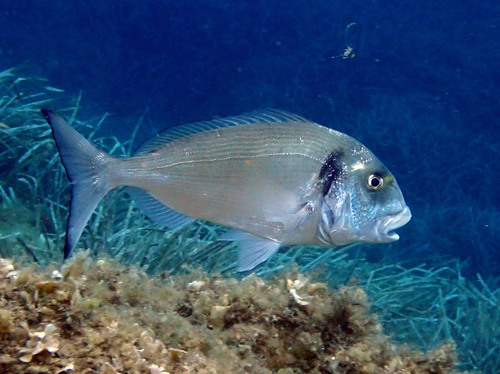
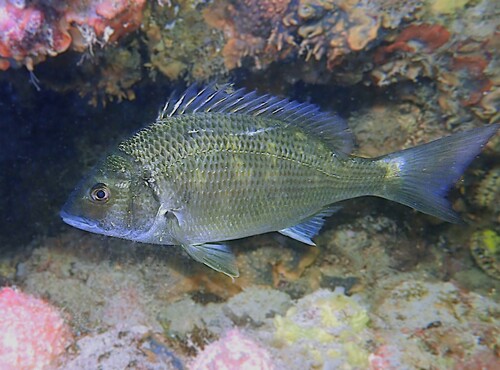
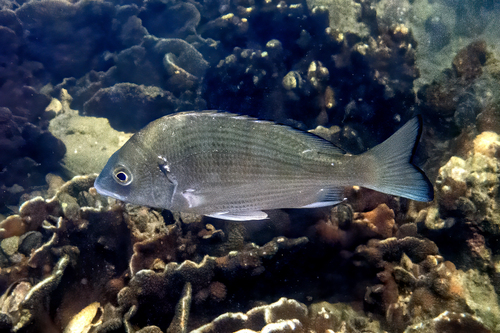
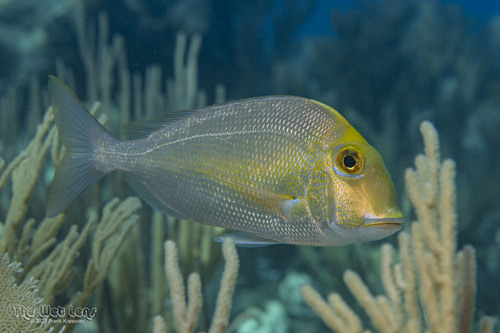
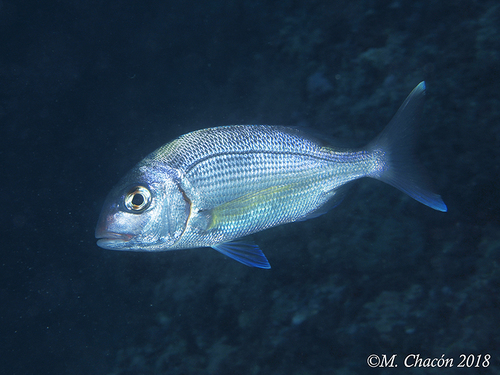
Pagrus pagrus, commonly known as the red porgy, is a fish with a moderately deep, oblong-shaped body. Its maximum recorded standard length is 75 cm (30 in), while most individuals reach around half this maximum size. Its dorsal fin has 11 to 13 spines and 9 to 10 soft rays, and its anal fin has 3 spines and 7 to 8 soft rays. The species has a silvery-pink body, with darker patches on the nape and behind the pectoral fins. Its caudal fin is dark pink with paler tips, and all other fins are pale pink.
The red porgy occurs in warm coastal waters on both sides of the Atlantic Ocean. On the Atlantic's eastern side, its range stretches from southern Britain to Western Sahara, and includes the waters around the Canary Islands and Madeira, the Mediterranean Sea, and the Sea of Marmara; it does not extend into the Black Sea. On the Atlantic's western side, its range runs from the eastern coast of the United States south to Argentina; it is found in the Gulf of Mexico and the western Caribbean Sea, but is absent from the eastern Caribbean. While it can be found as deep as 250 m (820 ft), it most commonly lives at depths between 10 and 80 m (30 and 260 ft) on continental shelves. It is a demersal species that inhabits both rocky areas and areas with soft sediment; juvenile red porgies often live in seagrass beds and will sometimes enter lagoons.
As demersal fish, red porgies feed mainly on or near the seabed, consuming crustaceans, molluscs, and small fish. They are protogynous hermaphrodites, meaning most individuals begin life as females and change sex to become male at some point in their lifetime. Red porgies reach sexual maturity at 2 or 3 years of age. Sex change occurs across a wide range of sizes, from 206 to 417 mm (8.1 to 16.4 in) total length, and across a wide range of ages, from 2 to 9 years. Not all red porgies change sex: some are primary males, whose ovarian tissue atrophies before they reach maturity; others are secondary males that function as females for a few reproductive cycles before changing sex; and some large individuals remain female their whole lives, only having rudimentary male tissue. There is some evidence that the timing of sex change in red porgies is linked to social or environmental factors.