About Pagellus acarne (Risso, 1827)
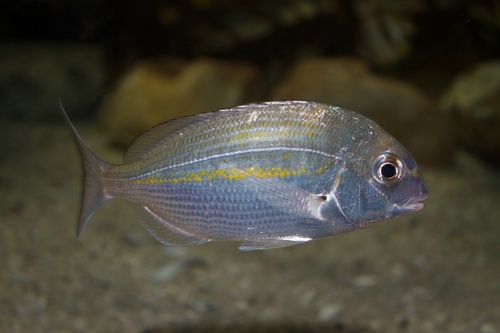
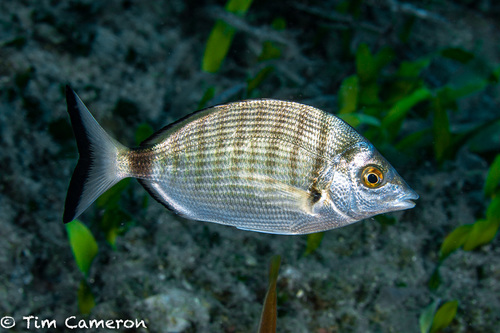
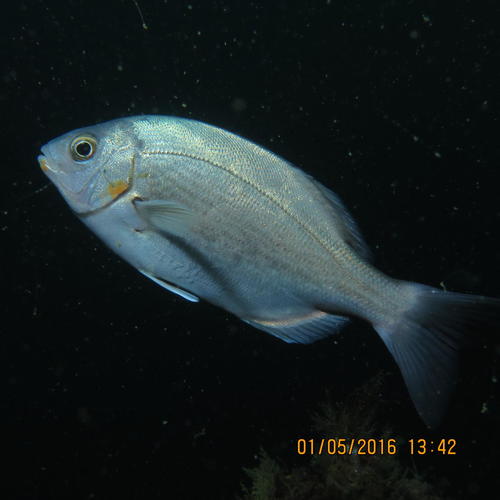
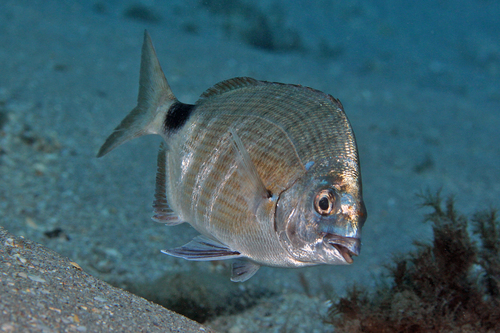
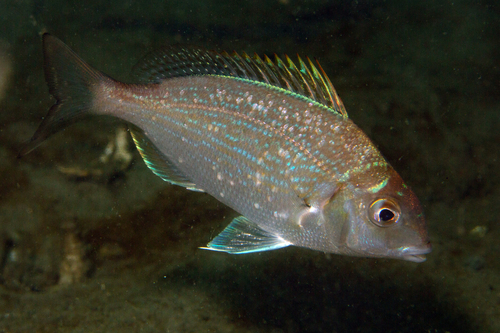
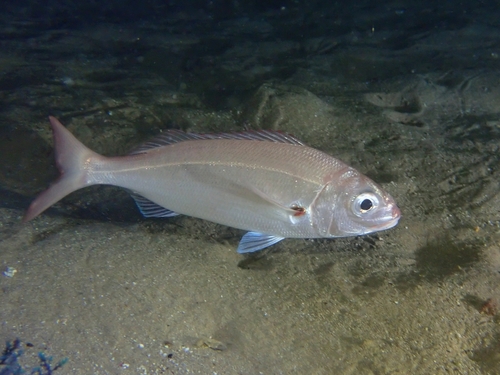
Pagellus acarne, commonly known as axillary seabream, has a moderately laterally flattened, fusiform body. Its head has a concave dorsal profile above the eyes, a flat interorbital space, and a conical snout. Scales on the crown extend to or past the level of the rear edge of the eye. Cheeks bear scales, but the preoperculum has no scales. The mouth is held horizontally and has fleshy lips. In each jaw, the front holds pointed teeth, the back holds molar-like teeth, and a band of numerous comb-like teeth sits immediately behind the front row of pointed teeth. The dorsal fin is supported by 12 or 13 spines and 10 to 12 soft rays, while the anal fin is supported by 3 spines and 9 or 10 soft rays. The rearmost ray of each of these fins is noticeably more robust than the other rays. The axillary seabream is overall greyish pink, darker on the dorsal side and paler on the ventral side. Its head is darker than the body, and the darkest area of the head is the space between the eyes. There is a reddish black spot at the base of each pectoral fin. Fins are pale pink, and the unpaired fins sometimes have brownish-red edges. The inside of the mouth is orange. The maximum published total length of this species is 36 cm (14 in), with 25 cm (9.8 in) being a more typical length. Pagellus acarne is distributed in the eastern Atlantic Ocean, ranging from the British Isles and Denmark, where it is rare in both areas, south through the Bay of Biscay and the Atlantic coast of Iberia to Senegal. This range also includes Madeira, the Canary Islands, the Azores, and Cape Verde. It is also found throughout the entire Mediterranean Sea and the Sea of Marmara, but it is not present in the Black Sea. This demersal species lives at depths between 0 and 500 m (0 and 1,640 ft), and is most common between 40 and 100 m (130 and 330 ft), where it occurs on a variety of substrates and in seagrass beds.