About Paeonia tenuifolia L.
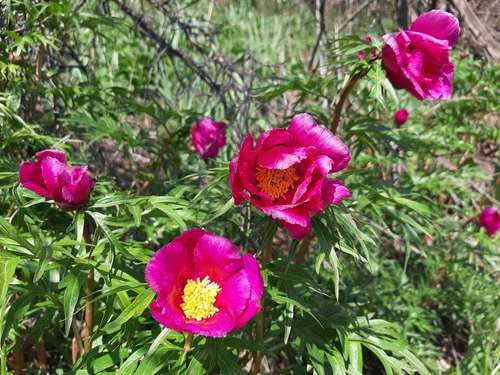
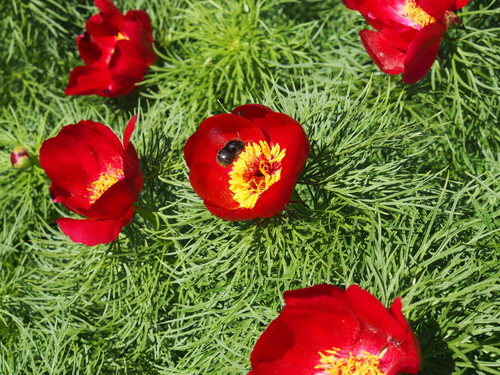
Paeonia tenuifolia L. is a hairless herbaceous perennial plant. Its stems grow 30–60 cm tall, and are densely covered with alternately arranged compound leaves. The lowest leaves are twice compounded, or their leaflets are deeply divided into many fine linear segments ½–6 mm wide, with blunt to rounded tips. Leaves are dark green on the upper surface, and lighter glaucous green on the lower surface. Each stem usually produces a single flower that appears to float above the foliage. The flower is 6–8 cm across, cup-shaped, with deep crimson, long inverted egg-shaped petals that have a rounded or blunt tip. Stamens measure 1½–2 cm long, with yellow filaments, anthers, and pollen. There are usually three, sometimes two, coarse felty-haired carpels, which eventually develop into 2 cm long, dry, dehiscent fruits called follicles. This species is diploid, with a chromosome count of 2n=10. Ecologically, P. tenuifolia flowers earlier than other peonies, and dies down earlier in the season as well. This is likely an adaptation to its native steppe habitat, which has dry, hot summers. Unlike most other peonies, the seeds of this species germinate above the soil in full light. The caterpillars of the moth Pelatea klugiana feed on the leaves of several Paeonia species, including Paeonia tenuifolia. Multiple larvae live together in a silk nest that binds several leaf lobes together, and only move within this nest. In cultivation, this hardy species is an attractive, easy-to-grow garden plant that is hardy in temperate zones. As a native of steppes in southern Russia and Kazakhstan, it is adapted to full sun, cold winters, and dry, hot summers, and is susceptible to mold growth on its leaves during prolonged wet spells. It has been cultivated in Germany since 1594, and was introduced to England in 1765 and to America in 1806. Several cultivars and hybrids are currently in cultivation. Paeonia tenuifolia 'Rosea' has pink flowers, while Paeonia tenuifolia 'Rosea Plena' has double pink flowers. Paeonia ×smouthii is a presumed hybrid with P. lactiflora that was commercially introduced in 1843, and is sometimes listed as P. laciniata in nursery catalogues. It is taller than P. tenuifolia, and usually has more than one flower per stem with a sweet perfume, traits inherited from P. lactiflora. It is diploid, and does not produce fertile seed. It was probably named in honor of M. Smout, a professional chemist at the Catholic University of Mechelen who was an active plant breeder. Paeonia ×majko, a presumed hybrid with P. daurica found in Georgia, is not considered particularly appealing. P. tenuifolia var. plena, a double-flowered variety, is recorded as having been introduced to English gardens in 1765. In 1818, Augustin Pyramus de Candolle described P. hybrida as a garden hybrid between P. anomala and P. tenuifolia that also occurred in the wild. However, Hong and Pan regard P. hybrida as a synonym of P. anomala.