About Paeonia californica Nutt. ex Torr. & A.Gray
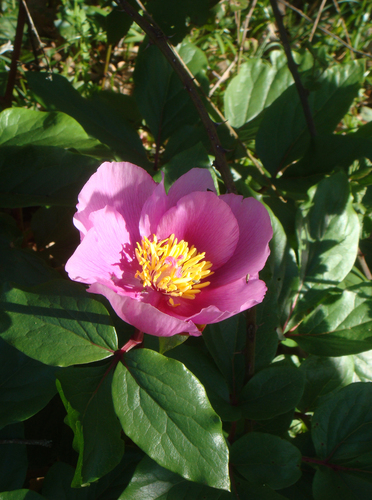
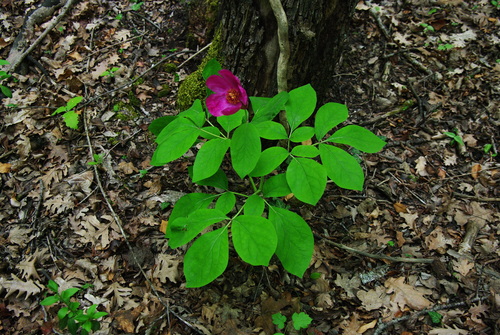
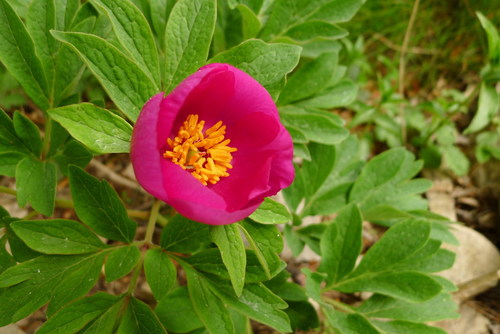
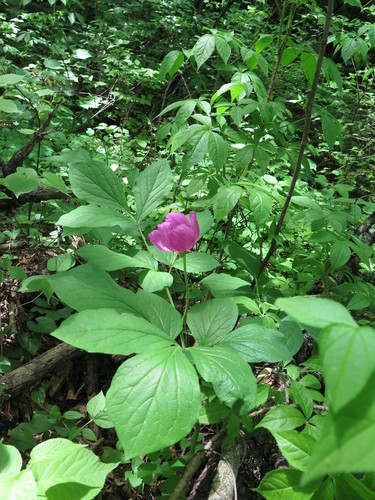
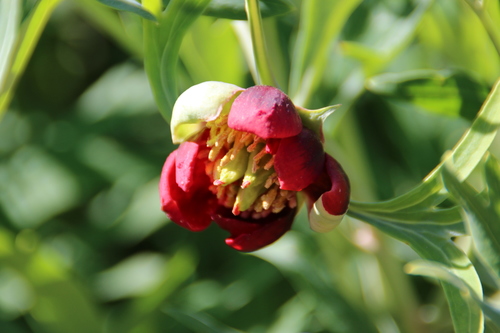
Paeonia californica Nutt. ex Torr. & A.Gray, commonly called the California peony, is a summer-deciduous perennial herb that grows 35–75 cm (14–30 in) tall. Each shoot typically bears seven to twelve compound leaves. Each primary leaf segment measures 3–9 cm (1.2–3.5 in) long and 1–6 cm (0.39–2.36 in) wide, with the smallest leaf divisions ranging from linear to spade-shaped. The blade of each leaflet gradually narrows into a short leaflet stalk, which may sometimes be absent entirely. Leaflet tips are usually pointed, and the leaf surface is green and not noticeably glaucous. Bisexual nodding flowers grow at the tip of each stem. Petals are dark red or purplish, sometimes appearing almost black, with lighter margins; they are elliptic in shape, 1.5–2.5 cm (0.59–0.98 in) long, and are usually longer than the sepals. Numerous stamens have filaments 0.5–0.8 cm (0.20–0.31 in) long topped with anthers 0.3–0.7 cm (0.12–0.28 in) long that hold yellow pollen. Two to five carpels mature into 3–4 cm (1.2–1.6 in) long follicles. The seeds are roughly 1.5 cm (0.59 in) long, slightly curved, and have a dull, coarsely wrinkled surface. Like all other diploid peonies, P. californica has ten chromosomes (2n=10). This species is native to southwestern California, specifically Los Angeles, Monterey, Orange, Riverside, Santa Barbara, San Bernardino, San Diego, San Luis Obispo and Ventura Counties, as well as neighboring northern Baja California in Mexico, though its distribution within Mexico is not well documented. It grows on dry hillsides in coastal sage scrub and chaparral communities of the coastal mountains of Southern and Central California, where it often grows as an understory plant, at elevations between sea level and 1,500 m (4,900 ft). The California peony is used in limited cultivation for native plant landscaping and xeriscaping. It is drought-tolerant and moisture-sensitive during the summer: if watered in summer, its swollen root will rot. It prefers partial sun and tolerates a wide range of soil types, and deer generally avoid eating it.