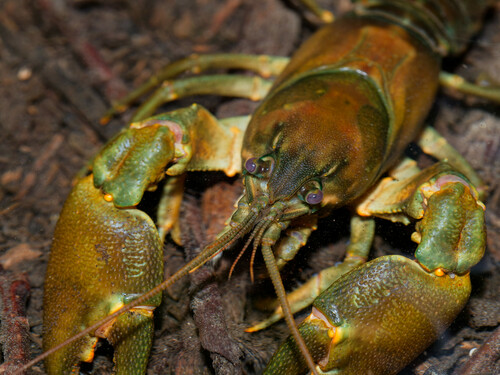
About Pacifastacus leniusculus (Dana, 1852)
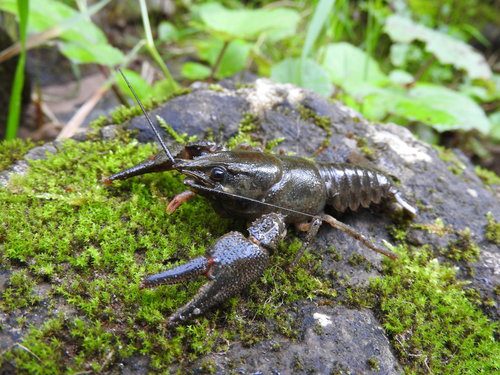
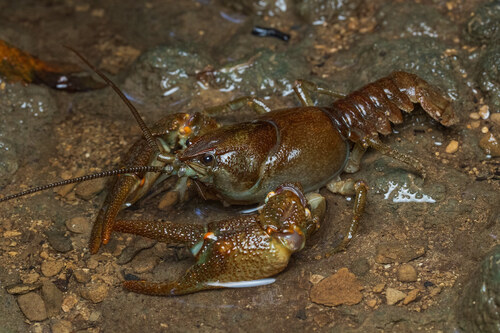
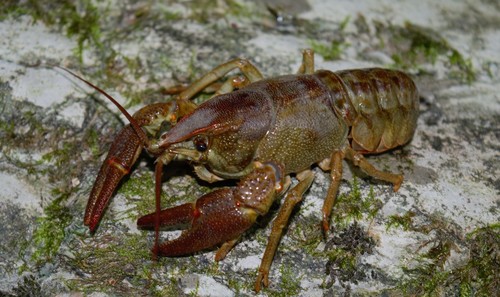
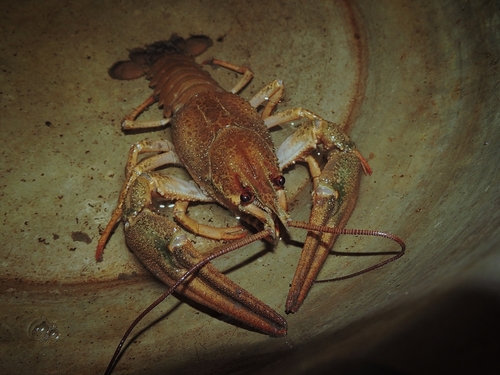
Description and ecology: Individuals of this species typically reach 6–9 cm (2.4–3.5 in) in length, though they can grow as large as 16–20 cm (6–8 in). A distinct white to pale blue-green patch located near the claw hinge gives the species its common name; this patch resembles the white flags historically used by signalmen to direct trains. The lifecycle of the signal crayfish follows the typical pattern for the family Astacidae. Mating takes place in autumn, after which females produce 200 to 400 eggs. Females carry the eggs under their tails until the eggs hatch the following spring. After hatching, juvenile signal crayfish go through three developmental stages that include two moults before they can leave their mother. The species reaches sexual maturity at two to three years old, and can live up to 20 years. Signal crayfish are omnivores, and their diet consists primarily of detritus. Adult signal crayfish can adapt to a wide range of salinity levels, substrate types, and environments with varying amounts of aquatic vegetation. Native range: Signal crayfish are endemic to North America west of the Rocky Mountains, including the Canadian province of British Columbia, and the U.S. states of Washington, Oregon, and Idaho. The species was introduced to California in 1912 into the San Lorenzo River watershed, and spread quickly across the entire state. Aside from Pacifastacus leniusculus klamathensis, a subspecies of signal crayfish thought to be native to the Klamath River in Northern California, the only native crayfish remaining in California is the Shasta crayfish (Pacifastacus fortis) of Shasta County, California, where efforts are underway to build a barrier that stops signal crayfish from invading its habitat. Within North America, signal crayfish have also been introduced to Nevada, and populations found in Utah likely stem from introductions. The species has also been recorded in Alaska, specifically on Kodiak Island, in the Buskin River and Buskin Lake. It is classified as a species of least concern on the IUCN Red List.