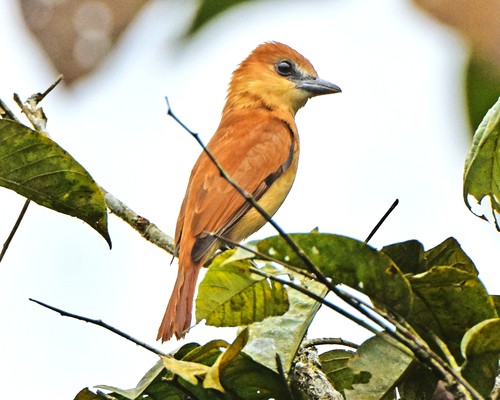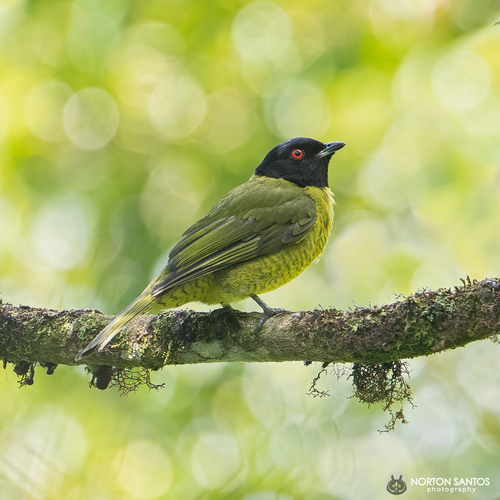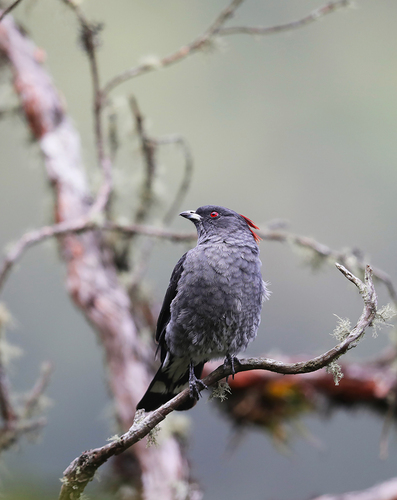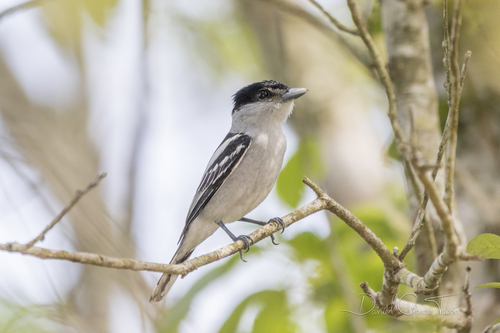
About Pachyramphus viridis (Vieillot, 1816)
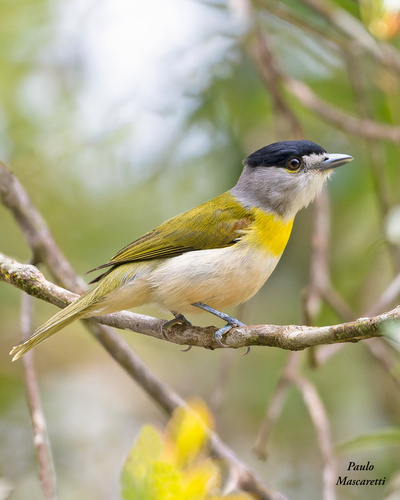
The green-backed becard, Pachyramphus viridis, measures about 14.5 to 16 cm (5.7 to 6.3 in) in length. Two individuals of the nominate subspecies weighed 18 g (0.63 oz) and 21 g (0.74 oz) respectively. For adult males of the nominate subspecies, the crown is glossy black, lores are whitish, and a thin yellowish eye-ring is present. The lower face and nape are pale gray. Most upperparts are bright olive, while flight feathers and tail are dusky olive. The throat is whitish, the breast is bright yellow to olive yellow, and the remaining underparts are grayish white with a buffy tinge. Adult females share a similar overall pattern to males, but differ in several features: their crown is dull olive, lores are grayish, and their face is grayer. Their upperparts are pale olive, wing coverts are rufous-chestnut, their breast is a more muted yellow, and their entire underparts are somewhat more dusky than those of males. For males of the subspecies P. v. griseigularis, the face and nape are grayish olive. Their flight feathers are blackish with olive edges, and their underparts are mostly grayish white, with grayer sides and flanks than the nominate subspecies. Females of this subspecies have a dusky brown crown, nape, and upperparts. Both sexes of both subspecies have a dark iris, a pale bluish horn bill, and dusky or grayish legs and feet. The green-backed becard has a disjunct distribution. The nominate subspecies holds by far the larger range. It occurs in eastern and southern Brazil, south from a line running roughly southwest from Ceará and Rio Grande do Norte to west-central Mato Grosso. Its range extends slightly from Mato Grosso into eastern Bolivia, then continues south through most of Paraguay into northeastern Argentina, reaching as far as the provinces of Santa Fe and Entre Ríos, and into northern Uruguay. From Argentina, the range loops north into central Bolivia. Subspecies P. v. griseigularis is found in the eastern portion of the eastern Venezuelan states of Delta Amacuro and Bolívar, extends slightly east into western Guyana, and also occurs in Brazil along the lower Amazon River from the lower Tapajós River to the river's mouth. The green-backed becard primarily lives in humid to moist forest in the tropical and lower montane zones, and prefers broken, somewhat open areas. It can also be found in riparian forest, terra firme forest, and the ecotone between these two forest types. It occurs from sea level up to 1,000 m (3,280 ft) in Brazil, and reaches the same elevation in Venezuela.