About Pachyramphus versicolor (Hartlaub, 1843)
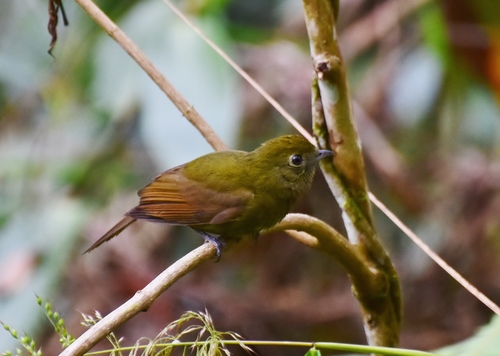
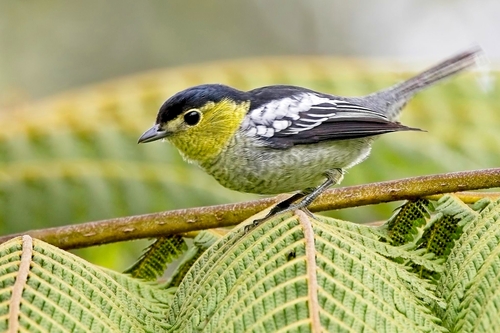
Description: The barred becard (Pachyramphus versicolor) measures 12 to 13 cm (4.7 to 5.1 in) long and weighs 14 to 17 g (0.49 to 0.60 oz), and is the smallest species in the genus Pachyramphus. Adult males of the nominate subspecies have glossy black crown and nape, with greenish yellow lores, eye-ring, and face. Their upperparts are mostly glossy black, with a slate gray rump and uppertail coverts. Their wings are black, with white edges on the greater coverts and remiges; their scapulars, and lesser and median coverts are white with black edges. Their tail is slate gray, with white edges on the feathers. Their throat is greenish yellow, fading to white on the rest of the underparts, and the entire underparts are overlaid with thin blackish bars. Adult females have slate gray crown and nape, and a yellow eye-ring; their face is a slightly more olive yellow than the male's. Their upperparts are olive green. Their wing coverts are rufous, and their flight feathers are a darker rufous with buff edges on the tertials. Their tail is brownish gray. Their breast is more olive than the male's, darkening across the rest of the underparts. They have dusky bars that are fainter than the bars on males. The other two subspecies are essentially identical to the nominate subspecies. Both sexes of all subspecies have a black iris, a black maxilla, a bluish gray mandible, and gray legs and feet. Distribution and habitat: The barred becard has a disjunct distribution. Of the three subspecies, P. v. costaricensis is the northernmost and has the smallest range. It occurs intermittently from the Tilarán Cordillera in Costa Rica's southern Alajuela Province, south into Chiriquí Province in western Panama. The nominate subspecies is found in the Serranía del Perijá on the Colombia-Venezuela border, and on the eastern slope of the Venezuelan Andes from Lara into Colombia. In Colombia, it occurs along both slopes of the Eastern Andes, extends south into the Central Andes from Norte de Santander Department, and extends south in the Western Andes from Valle del Cauca Department. From Colombia, its range continues into the Andes of Ecuador, reaching Chimborazo Province on the western Andean slope and Zamora-Chinchipe Province on the eastern Andean slope. P. v. meridionalis is found in Peru along the western Andean slope from the Ecuadorian border south to Cajamarca Department, and along the eastern Andean slope from southern Amazonas Department south to northern Puno Department. It also occurs at scattered locations in northwestern Bolivia. The barred becard inhabits a variety of landscapes in the subtropical and lower temperate zones, including cloudforest, elfin forest, and humid montane woodlands. It can be found in both somewhat open forest and scrubby ravines. Its elevation range varies by region: between 1,500 and 2,300 m (4,900 and 7,500 ft) in Costa Rica; between 2,000 and 2,900 m (6,600 and 9,500 ft) in Venezuela; between 1,500 and 2,800 m (4,900 and 9,200 ft) in Colombia; mostly between 1,500 and 2,600 m (4,900 and 8,500 ft) in Ecuador; and mostly between 1,500 and 3,000 m (4,900 and 9,800 ft) in Peru, though it occurs locally as low as 1,100 m (3,600 ft) there.