About Pachyramphus validus (Lichtenstein, 1823)
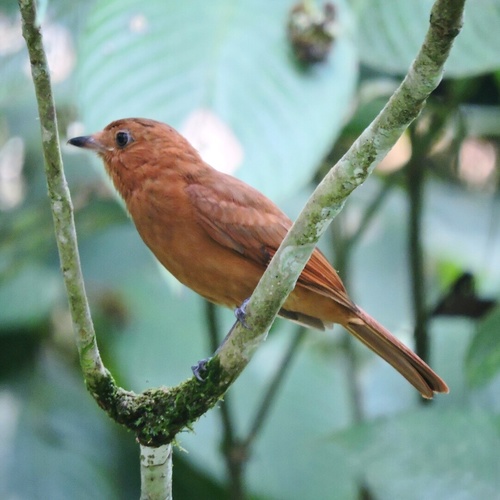
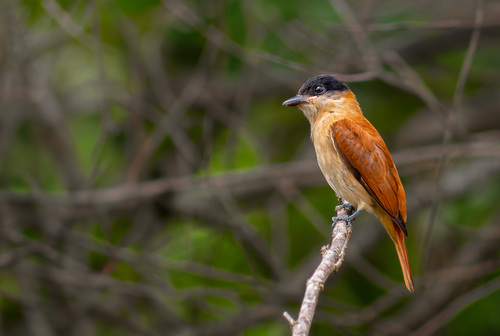
The crested becard (Pachyramphus validus) measures 17 to 18.5 cm (6.7 to 7.3 in) in length, and the species is sexually dimorphic. While its crown is somewhat shaggy, it does not have an obvious raised crest. Adult males of the nominate subspecies have mostly dark grayish to almost black coloring on their crown, upperparts, wings, and tail, with a partially hidden white patch on the back and some white on the scapulars. They have a smoky gray spot above the lores on an otherwise grayish face. Their throat is whitish gray, and their underparts are pale smoky grayish with a cinnamon tinge. Adult females have a dark grayish brown crown and a bright rufous nape. They have a buff-grayish spot above the lores on an otherwise cinnamon face. Their upperparts and tail are bright rufous. Their wings are mostly dusky, with thin rufous edges on the primaries and fully rufous inner flight feathers. Their throat is yellowish cinnamon, and their underparts are dull buffy cinnamon. Males of subspecies P. v. audax have little to no cinnamon tinge on their underparts, a more grayish white throat, and darker wings than the nominate subspecies. Females of P. v. audax have a more sooty crown, darker wings with duskier inner flight feathers, and darker underparts than the nominate. Both sexes of both subspecies have a dark brown iris, a black maxilla, a medium gray mandible, and dark gray legs and feet. Pachyramphus validus has two recognized subspecies, of which P. v. audax is the more westerly. It is found in the southern Peruvian departments of Junín, Ayacucho, and Cuzco. Its range continues through northwestern, central, and southern Bolivia, and extends south into northwestern Argentina as far as Córdoba Province. The nominate subspecies occurs in Brazil south and east of a rough line running from Rondônia to Tocantins to northeastern Pará. Its range continues south within Brazil to northern Rio Grande do Sul, and extends across eastern Bolivia and Paraguay into northeastern Argentina to Santa Fe Province. The nominate subspecies also occurs as a rare austral migrant in extreme southeastern Peru. There is a single unconfirmed record from extreme southern Ecuador that is tentatively assigned to P. v. audax; the South American Classification Committee does not recognize this record. The crested becard inhabits semi-arid to semi-humid woodlands and montane forest. It favors the forest canopy and edges, and also occurs in wet ravines. In terms of elevation, it ranges from sea level to 2,000 m (6,600 ft) in Brazil, and between 1,700 and 3,400 m (5,600 and 11,200 ft) in Peru.