About Pachyramphus rufus (Boddaert, 1783)
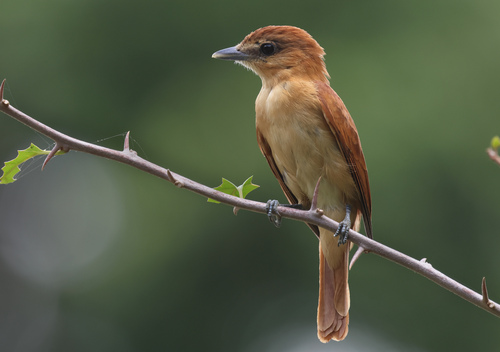
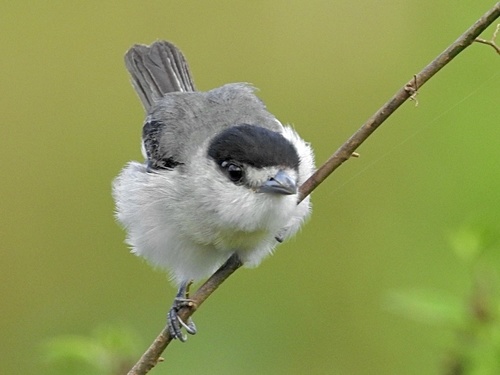
The cinereous becard (Pachyramphus rufus) measures 12.9 to 14 cm (5.1 to 5.5 in) long and weighs approximately 18.5 g (0.65 oz). Adult males of the nominate subspecies have a glossy black crown, white forehead and lores, a dusky spot in front of the eye, and pearl-gray cheeks. Their upperparts are mostly pearl-gray, and sometimes bear a faint olive tinge on the upper back. Their wings are blackish, with thin white edges on the outer flight feathers and wider white edges on the inner flight feathers and coverts. Their tail is slaty gray, and the feathers sometimes have whitish edges at their tips. Their throat is whitish, and their underparts are light grayish, darkest on the upper breast. Adult females have a dark chestnut-rufous crown, whitish to whitish gray lores, and a light buffy cinnamon face. Their upperparts are bright cinnamon-rufous. Their wing flight feathers are blackish with rufescent edges, and the greater coverts are cinnamon-rufous. Their tail is cinnamon, their throat is whitish, and their upper breast is buffy cinnamon that fades to white on the rest of their underparts. For the subspecies P. r. juruanus, males have the black crown color extending further back onto the nape than the nominate subspecies, while females have more cinnamon-rufous color on the underparts than the nominate. Both sexes of both subspecies have a dark iris, a blackish bill, and grayish legs and feet.
The cinereous becard ranges from southern Panama across northern South America and the Amazon Basin. Of the two subspecies, the nominate is the more northerly and has a much larger range. It occurs from the Panama Canal region across northern Colombia; in Colombia, its range extends west south to Valle del Cauca Department, and east of the Andes to Meta Department. From Colombia, its range continues east across northern Venezuela and the Guianas to the Atlantic coast in Brazil's Amapá state, and extends south from there in Brazil to Mato Grosso. Subspecies P. r. juruanus is found from Loreto Department in eastern Peru east into western Brazil's Amazonas state. The species is only tentatively recorded in Ecuador from old specimens, and the South American Classification Committee has no confirmed records from the country.
The cinereous becard lives in a wide variety of forest types in the tropical and lower subtropical zones. These include gallery forest, secondary forest, the edges of evergreen forest, deciduous woodlands, some scrublands, and agricultural areas and pastures with scattered trees. It also occurs in mangroves in coastal areas. In Panama, it is found between 750 and 1,500 m (2,500 and 4,900 ft) elevation; in Colombia, from sea level to 1,500 m (4,900 ft); and in Venezuela, from sea level to 1,300 m (4,300 ft).