About Pachyramphus polychopterus (Vieillot, 1818)
Scientific name: Pachyramphus polychopterus (Vieillot, 1818)
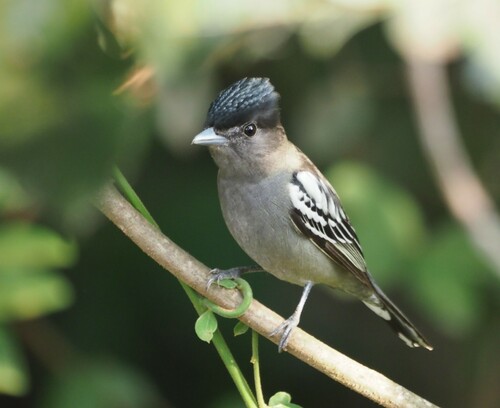
The white-winged becard measures 14 to 15.5 cm (5.5 to 6.1 in) in length and weighs 19.5 to 21 g (0.69 to 0.74 oz). Adult males of the nominate subspecies P. p. polychopterus have a glossy black to near-bluish crown and nape. The area of the face below the crown is slate-gray, and this color wraps around the back of the neck. The back is mostly glossy black to near-bluish, with slate-gray uppertail coverts. The wings are mostly black, with wide white edges on the coverts that form two distinct wing bars. The wing's secondaries and tertials also have wide white edges. The tail is long and mostly black, with wide white tips on all feathers except the central pair. The throat and underparts are mostly slate-gray, with a paler belly.
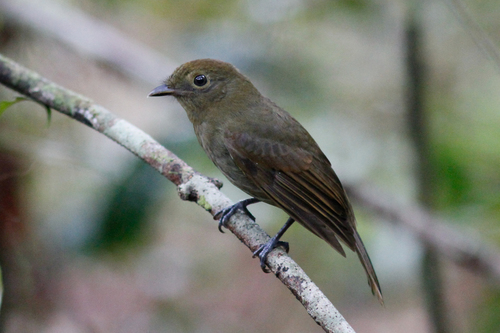
Adult females have a brown-olive crown, a pale whitish stripe above the lores, and a partial white eye-ring on an otherwise pale yellowish face. Their upperparts are brownish olive to greenish olive. Their wings have wide buff-cinnamon edges on the scapulars, coverts, and inner flight feathers. Their tail is blackish with wide buff-cinnamon tips on the feathers. Their throat is grayish yellow, and their underparts are pale yellowish with an olive tinge on the breast and sides.
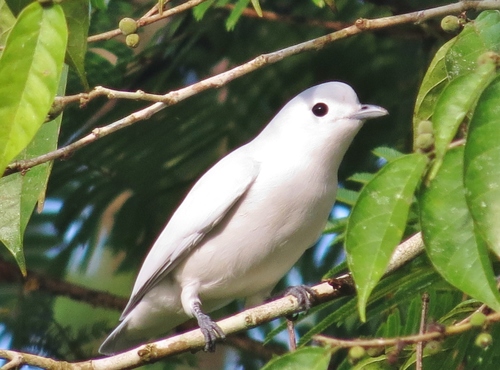
Other subspecies of the white-winged becard differ from the nominate subspecies and one another as follows: P. p. similis (male) has a black head and upperparts, medium gray underparts, and white speckles on the belly. P. p. cinereiventris (male) has more white on the wings than the nominate subspecies, with a pale gray neck, rump, and underparts; its female has more olivaceous upperparts than the nominate. P. p. dorsalis (male) is rather similar to cinereiventris but has much paler underparts. P. p. tristis (male) has a black head and upperparts, slaty gray underparts, and white speckles on the belly. P. p. tenebrosus (male) has a black head and upperparts, sooty black underparts, white wing bars, and white tips on outer tail feathers; its female has more rufescent underparts than the nominate. P. p. nigriventris (male) is almost entirely black, with white edges on wing coverts and white tips on tail feathers; its female has grayish olive upperparts. P. p. spixii (male) has shiny black head and upperparts, white wing bars, pale gray edges on flight feathers, and gray underparts.
All subspecies have a dark iris, a blackish or silver-gray bill with a black tip, and dark gray or plumbeous legs and feet.
The white-winged becard has the largest geographic range of any species in the genus Pachyramphus. Subspecies are distributed as follows: P. p. similis ranges from southern Belize and central Guatemala south along the Caribbean slope through Honduras, and along both the Caribbean and Pacific slopes through Nicaragua, Costa Rica, and Panama, extending slightly into far northwestern Colombia's Chocó Department. P. p. cinereiventris is found in northern Colombia except far northern Chocó, east to the Magdalena and Cesar departments. P. p. dorsalis ranges from central and southwestern Colombia (Antioquia and Cundinamarca departments) south into northwestern Ecuador as far as Pichincha Province. P. p. tristis occurs on Trinidad and Tobago; from northeastern Colombia east of the Andes east across Venezuela (excluding Cerro Duida), across the Guianas and into northeastern Brazil, from Roraima to the Atlantic coast in Maranhão. P. p. tenebrosus ranges from Nariño to Amazonas departments in southeastern Colombia, south through eastern Ecuador into northeastern Peru, through Loreto Department and into San Martín Department. P. p. nigriventris ranges from western Meta Department in southeastern Colombia south through eastern Peru south of the Marañón River to Ucayali Department and northern Bolivia, and extends southeast into western Brazil along the upper Amazon to the Nhamundá and Madeira rivers. P. p. polychopterus (the nominate subspecies) is found in eastern Brazil, from Piauí and Ceará south to Alagoas and Bahia. P. p. spixii occurs in far southeastern Peru and northwestern Bolivia, and extends east across southern Brazil, south through Paraguay, Uruguay, and northern Argentina to Buenos Aires Province.
The white-winged becard inhabits a wide variety of landscapes in the tropical and lower subtropical zones. Most of its habitats are somewhat open, including evergreen forest edges and clearings, gallery and riparian forest, secondary forest, shaded plantations, and river islands. It sometimes occurs in mangroves and in regrowing várzea forest.
In terms of elevation, it ranges from sea level to 1,100 m (3,600 ft) in northern Central America, to 1,200 m (3,900 ft) in Costa Rica, to 1,300 m (4,300 ft) in Colombia, and to 900 m (3,000 ft) in eastern Ecuador. In northwestern Ecuador, its elevation ranges between 600 and 1,500 m (2,000 and 4,900 ft). It reaches 1,200 m (3,900 ft) and locally 1,500 m (4,900 ft) in Peru, 1,900 m (6,200 ft) in Venezuela, and mostly reaches 1,500 m (4,900 ft) but occurs locally higher in Brazil.