About Pachyramphus minor (Lesson, 1831)
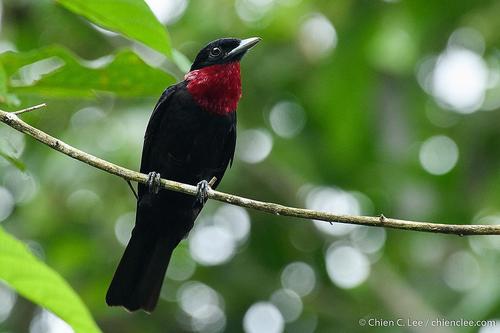
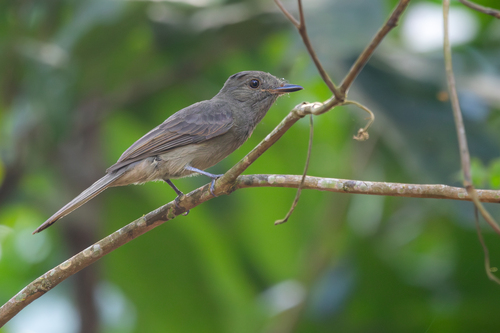
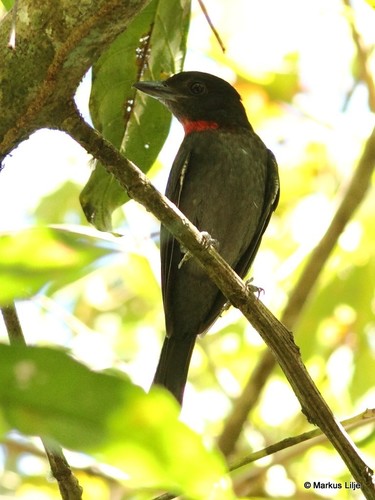
The pink-throated becard (Pachyramphus minor, first described by Lesson in 1831) measures 16.5 to 17.5 cm (6.5 to 6.9 in) long and weighs 31 to 44 g (1.1 to 1.6 oz). This species is sexually dimorphic, with distinct plumage for adult males and adult females. Adult males are mostly black to dark sooty gray; their face and underparts are slightly paler than their back. They have the namesake pink patch on the lower throat and upper breast, though this patch is sometimes indistinct. They have a small amount of white at the bend of the wing that is usually only visible during flight. Adult females have plumage that varies somewhat between individuals. In general, they have a grayish brown crown and nape, and a small buff spot above the lores on an otherwise buff-colored face. Their back is gray, their rump is gray with a rufous tinge, and their wings and tail are rufous. Their throat and underparts are buff. Both sexes have brown to dark brown irises. Their bill can be entirely black, or have a black upper mandible (maxilla) and a gray lower mandible (mandible). Their legs and feet range from blackish to gray.
This becard is native to the Amazon Basin and the Guiana Shield. Its range stretches from southeastern Colombia south through eastern Ecuador and eastern Peru into northern Bolivia. From this southern extent, its range extends east across southern and eastern Venezuela, the Guianas, and all of Brazil north of a line that runs roughly from southern Mato Grosso do Sul northeast to the Atlantic coast in Maranhão. It lives in a variety of forested landscapes, with evergreen terra firme as its preferred habitat. It can also be found in várzea forests, swamp forests, and savanna forests. Its maximum elevation range varies by country: from sea level to 800 m (2,600 ft) in Brazil, to 500 m (1,600 ft) in Colombia, 600 m (2,000 ft) in Ecuador, 1,000 m (3,300 ft) in Peru, 1,300 m (4,300 ft) in Bolivia, and 800 m (2,600 ft) in Venezuela.