About Pachyramphus marginatus (Lichtenstein, 1823)
The black-capped becard, scientific name Pachyramphus marginatus (Lichtenstein, 1823), measures 13 to 14 cm (5.1 to 5.5 in) long and weighs approximately 18 g (0.63 oz).
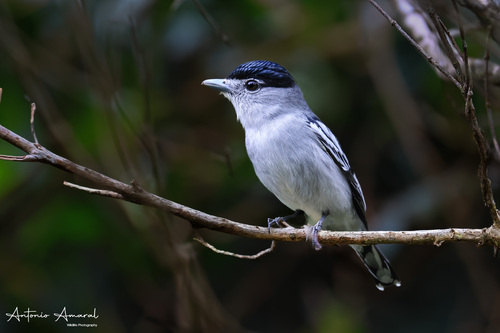
Adult males of the nominate subspecies have a glossy blue-sheen black crown with a scaly texture. They have a pale spot above the lores and a thin whitish eye-ring on an otherwise light gray face. The gray facial color extends around the nape to form a collar. Their back varies in color from gray to black, and their rump is gray. Their wings are mostly black, with white scapulars and fairly wide white edges on the coverts and flight feathers; the white markings form two distinct wing bars. Their tail is black, with white tips on each feather. Their throat is pale gray or pale whitish gray, and their underparts are a uniform light gray that sometimes lightens to whitish gray on the lower belly and vent.
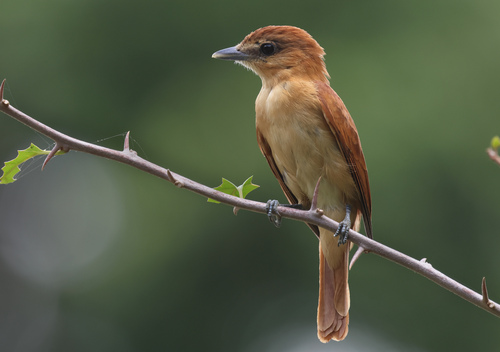
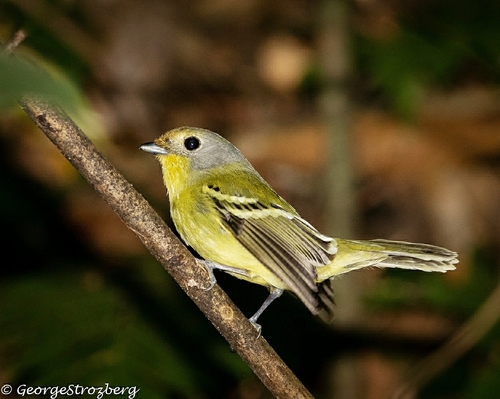
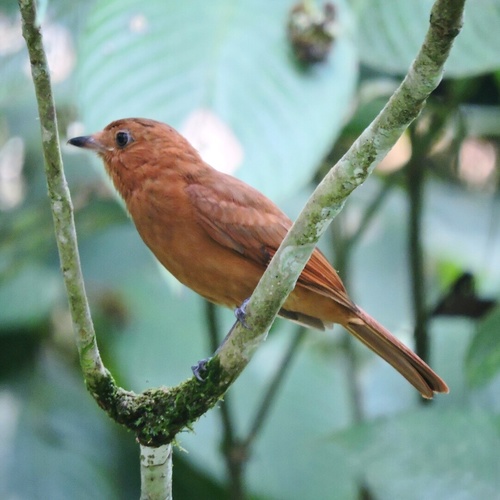
Adult females have a rufous-chestnut crown. They have a grayish spot above the lores and a broken white eye-ring on an otherwise dusky olive face, and the facial color wraps around their nape. Their upperparts are olive. Their wings are mostly dusky, with rufescent or cinnamon-olive scapulars and wide rufous edges on the coverts and inner flight feathers. Their tail is dusky, with buff-cinnamon tips on the feathers. Their throat and underparts are pale yellow, with a dusky tinge across the breast.
The subspecies P. m. nanus is smaller than the nominate subspecies, but is otherwise identical in appearance. Both subspecies have a dark iris, a dusky or blackish bill, and dusky grayish legs and feet.
The black-capped becard has a disjunct distribution, with P. m. nanus occupying by far the larger range of the two subspecies. P. m. nanus ranges from southeastern Colombia south through eastern Ecuador and eastern Peru into northern Bolivia, and extends east across southern and eastern Venezuela, the Guianas, and Amazonian Brazil. In Brazil, its range reaches east roughly to a line running from west-central Mato Grosso northeast to the Atlantic coast in Maranhão. The nominate subspecies occurs in eastern Brazil, from Pernambuco south to eastern Paraná.
The black-capped becard primarily lives in the interior of terra firme forest and mature secondary forest, and occurs less commonly at forest edges. Its elevation range extends from sea level to 1,000 m (3,300 ft) in Brazil, up to 500 m (1,600 ft) in Colombia, 700 m (2,300 ft) in Ecuador, 750 m (2,500 ft) in Peru, and 1,000 m (3,300 ft) in Venezuela.