About Pachyramphus major (Cabanis, 1847)
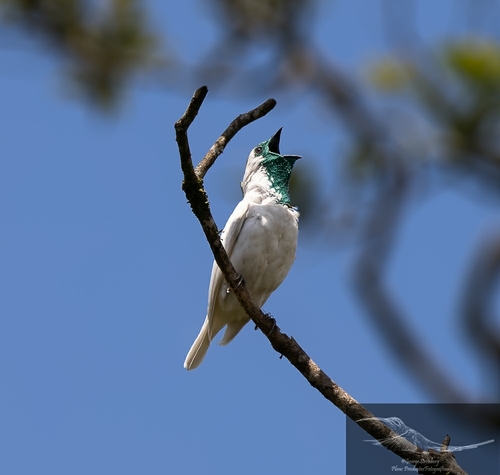
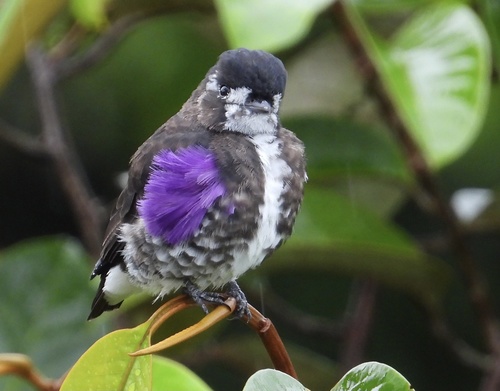
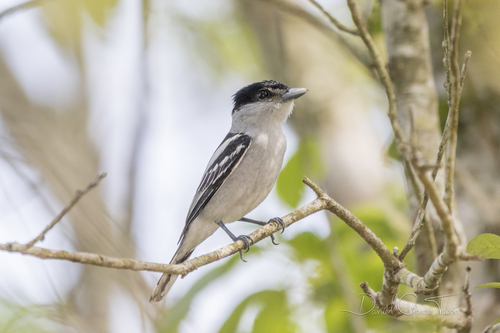
The grey-collared becard (Pachyramphus major) is 14 to 16.3 cm (5.5 to 6.4 in) long and weighs approximately 21 to 28 g (0.74 to 0.99 oz). For the nominate subspecies P. m. major, adult males have a glossy black crown, a pale stripe above the lores, and an otherwise light gray face. The gray color of the face extends around the neck to form a collar. Their back is black, sometimes marked with gray mottling, while the rump and uppertail coverts are gray. Their wings are mostly black, with a white stripe on the scapulars and white edges on the coverts, secondaries, and tertials. Their tail is black, with white tips on the outer feathers. Their throat and underparts are uniform light gray. Adult females of the nominate subspecies have a blackish brown to glossy blackish crown. They have a pale stripe above the lores, with the rest of the face ranging from pale cinnamon to tawny-buff. The face color wraps around the neck as a collar. Their upperparts are cinnamon-brown. Their wings are mostly blackish, with wide cinnamon to cinnamon-brown edges on the coverts, secondaries, and tertials. Their tail is mostly cinnamon-brown, with wide cinnamon tips on the feathers. Their throat and underparts are buff to cinnamon-buff. Other subspecies of the grey-collared becard differ from the nominate subspecies and from each other as follows: P. m. uropygialis: males have whitish rump and uppertail coverts; females have rufous crown and lemon-colored face and underparts. P. m. matudai: females have buffy-lemon underparts. P. m. itzensis: males have a mostly gray back. P. m. australis: males are paler than the nominate subspecies; females are darker than the nominate subspecies. All subspecies have a dark iris, a blackish bill that sometimes has grayish pink on the mandible, and dark gray legs and feet. Subspecies of the grey-collared becard are distributed as follows: P. m. uropygialis is found in western Mexico, from southern Sonora south to Guerrero and Oaxaca. P. m. major is found in eastern Mexico, from southern Nuevo León south to Oaxaca and western Chiapas. P. m. matudai is found on the Pacific slope from Chiapas south to southern Guatemala. P. m. itzensis is found in Campeche, Yucatán, and Quintana Roo in southeastern Mexico. P. m. australis is found in El Salvador, Honduras, and north-central Nicaragua. Populations in Belize and northern Guatemala belong to either P. m. itzensis or P. m. australis. The grey-collared becard lives in multiple types of humid to semi-arid forest in tropical and subtropical zones, including evergreen forest, deciduous forest, and especially pine-oak forest. Its elevation range extends from sea level up to 2,500 m (8,200 ft).