About Pachyramphus homochrous P.L.Sclater, 1859
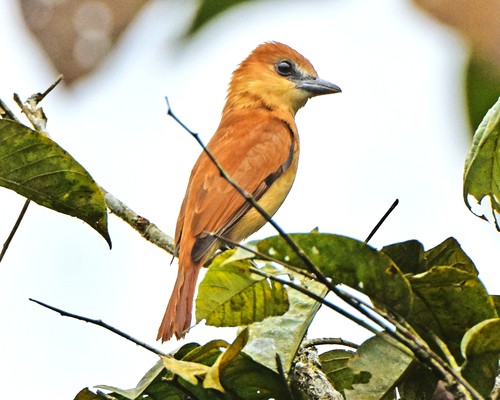
Pachyramphus homochrous, commonly called the one-colored becard, measures about 16.5 cm (6.5 in) long and weighs approximately 35 g (1.2 oz). The species is sexually dimorphic. Adult males of the nominate subspecies have mostly dark slaty gray head and upperparts, with a slightly darker crown and lighter rump. Their wings and tail are dark slaty gray, with paler edges along the remiges. Their underparts are somewhat paler gray than their upperparts. Males sometimes have a faint pinkish wash on the throat, and a slight dusky tinge on the breast and upper belly. Adult females have rufous-chestnut to rufous tawny crown, upperparts, and tail. Their wings have cinnamon-edged primaries, and cinnamon-edged rufous secondaries and coverts. Females have a whitish cinnamon spot above the lores, on an otherwise buff-cinnamon face. Their underparts are mostly buffy cinnamon, with more whitish and cinnamon coloring on the throat. Subspecies P. h. quimarinus matches the appearance of the nominate subspecies. P. h. canescens has a slightly lighter throat and belly than the nominate subspecies.
The nominate subspecies of the one-colored becard has the largest range of the three recognized subspecies. It occurs in central and eastern Panama: on the Caribbean slope in the Canal area, on both slopes in eastern Panamá Province, and in the Pacific lowlands of Darién Province. Its range extends south along the Pacific slope of Colombia's Western Andes at least to southern Chocó Department, and one source notes the range continues from Colombia all the way to Ecuador. The full range of the nominate subspecies also covers the entire length of western Ecuador, and continues into the Tumbes and Piura departments of northwestern Peru. Subspecies P. h. quimarinus is found in the northwestern Colombian departments of Antioquia, Bolívar, and Magdalena. P. h. canescens occurs in Colombia northeast of the range of P. h. quimarinus, in Bolívar and Magdalena departments, and in Venezuela on the eastern side of the Serranía del Perijá, and on the eastern and western sides of Lake Maracaibo.
The one-colored becard inhabits a range of forest types in the tropical zone, including humid evergreen forest, drier deciduous forest, gallery forest, and secondary forest. It can also be found in clearings and arid scrublands that contain tall trees. Across its entire range, it is mostly found from sea level to 900 m (3,000 ft) in elevation. It reaches up to 1,000 m (3,300 ft) in Colombia, 1,500 m (4,900 ft) in Ecuador, 700 m (2,300 ft) in Peru, and 500 m (1,600 ft) in Venezuela.