About Pachyramphus cinnamomeus Lawrence, 1861
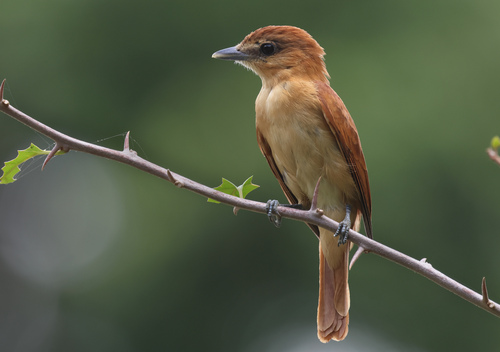
The cinnamon becard (Pachyramphus cinnamomeus Lawrence, 1861) is 14 to 15 cm (5.5 to 5.9 in) long and weighs 17 to 22 g (0.60 to 0.78 oz). Males and females share identical plumage. Adults of the nominate subspecies P. c. cinnamomeus have a deep rufous crown, dusky lores, a pale buff line above the lores, and ochraceous tawny cheeks. Their upperparts are mostly rufous, chestnut-rufous, or rufous-tawny. Their wings are primarily rufous, with darker, duskier coloring on the primary coverts. Their tail is rufous. Their underparts range from ochraceous tawny to cinnamon-buff or tawny-buff, with paler coloring on the throat and belly, and a rufous tinge across the breast. Subspecies P. c. fulvidior has more intense, richer coloring than the nominate subspecies. P. c. magdalenae has underparts that are more whitish than the nominate’s, with a cinnamon wash. P. c. badius is similar to P. c. magdalenae but slightly darker. All subspecies have a dark iris, a blackish bill that often has a paler grayish lower mandible, and dark gray legs and feet. The four recognized subspecies have the following distinct ranges. P. c. fulvidior occurs from southeastern Veracruz and northeastern Oaxaca in southeastern Mexico, south through central and southern Belize, northern Guatemala, and the Caribbean slopes of Honduras, Nicaragua, and Costa Rica, into western Panama; it is also found on the Pacific slope from Costa Rica's Puntarenas Province south into western Panama. P. c. cinnamomeus ranges from Darién Province in eastern Panama south into northwestern Colombia; in Colombia's Eastern Andes it occurs regularly south to Meta Department, and at least occasionally further south; it also ranges south through western Colombia and through western Ecuador almost to Peru. P. c. magdalenae is found in northern Colombia's Magdalena River valley, and from northern Sucre Department east into western Venezuela's Zulia, Táchira, and Mérida states. P. c. badius occurs on the east slope of the Andes in Táchira, western Venezuela. The cinnamon becard inhabits the interior and edges of evergreen forest and secondary forest in the tropical and lower subtropical zones. It also lives in somewhat open woodlands, riparian areas, clearings with tall trees, and coastal mangroves. Across its entire range, it occurs from sea level up to most 1,200 m (3,900 ft) in elevation. Regional maximum elevations are 500 m (1,600 ft) in northern Central America, 900 m (3,000 ft) in Costa Rica, 1,300 m (4,300 ft) in Colombia, 800 m (2,600 ft) in Ecuador, and 1,200 m (3,900 ft) in Venezuela.