About Pachyptila desolata (Gmelin, 1789)
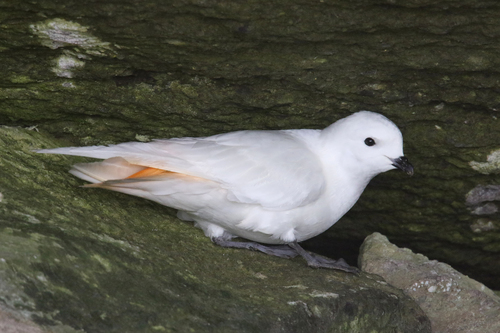
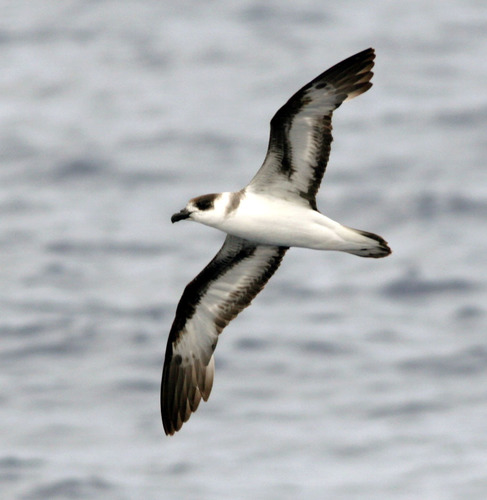
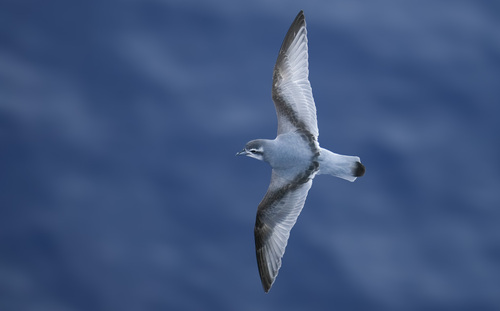
This species is scientifically named Pachyptila desolata (Gmelin, 1789), commonly known as the Antarctic prion. The Antarctic prion has an overall length of 27 cm (11 in), a wingspan of 61–66 cm (24–26 in), and weighs 150–160 g (5.3–5.6 oz). Like all prions, it has white underparts and blue-grey upperparts, with a dark "M" marking extending from its back to its wingtips. It features a white eyebrow, blue-grey bill, and blue feet. Its tail is grey, wedge-shaped, and has a black tip. The greater coverts on its wings are nearly black. It looks so similar to Salvin's prion that the two species cannot be told apart when observed at sea. For distribution and habitat, it breeds in colonies on the Auckland Islands, Heard Island, Macquarie Island, Scott Island, South Georgia and the South Sandwich Islands, the South Orkney Islands, the South Shetland Islands, the Crozet Islands, and the Kerguelen Islands. When it is not breeding, it ranges across the entire southern oceans. In terms of feeding behavior, like all prions, the Antarctic prion feeds primarily on zooplankton, which it collects by filtering water through its upper bill.