About Pachyphytum compactum Rose
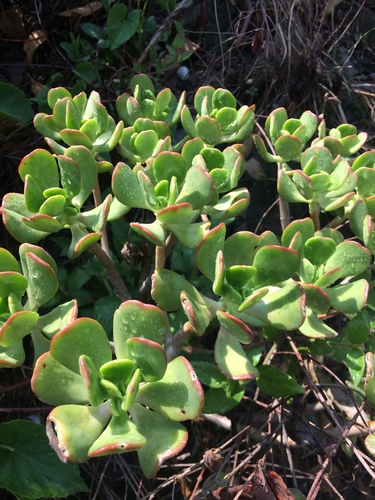
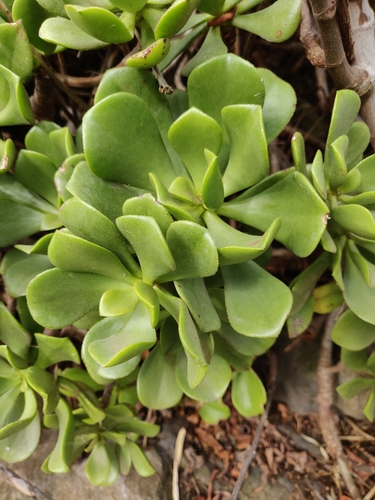
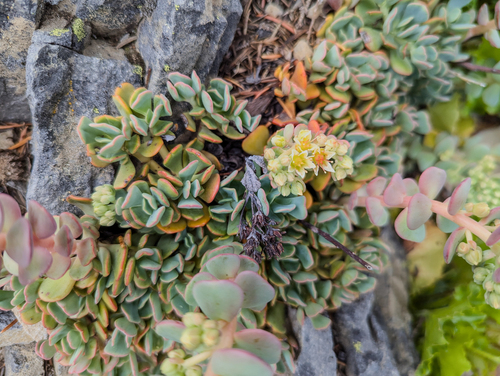
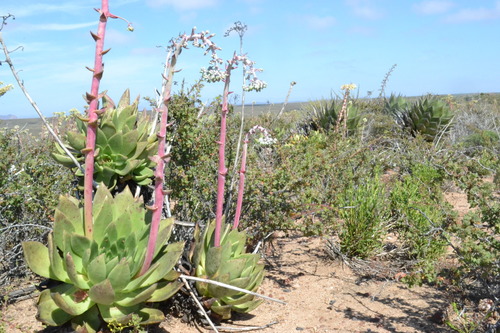
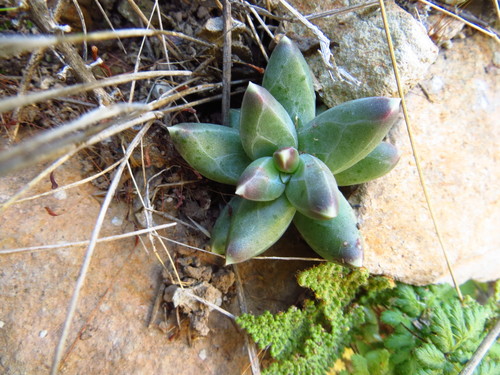
Pachyphytum compactum Rose is an herbaceous, sometimes slightly woody succulent plant with several distinguishing features. It either lacks a stem and grows in a rosette form, or develops a stem up to 30 cm (12 in) tall as it ages. The stem can branch at the base to produce offsets, which eventually grow into dense colonies. Its leaves are semi-rounded, measuring up to 40 mm × 16 mm × 12 mm (1 5⁄8 in × 5⁄8 in × 1⁄2 in), with slightly angled, faceted upper surfaces. On stemmed plants, leaves cluster at the apex of the stem. Leaves are covered in an easily rubbed-off grayish, bluish, or whitish waxy bloom, giving them a glaucous appearance. Inflorescences grow from pale green to reddish peduncles up to 40 cm (16 in) tall, which bear noticeable scale-like bracts. The inflorescences are scorpioid cymes, meaning their tops curve like a scorpion's tail, with the lowest flower blooming first, and higher flowers opening successively from bottom to top. Sepals are dark rose to reddish with green tips, and are glaucous. Petals are bicolored, reddish to orangish with green tips. Stamens have yellow pollen-producing filaments. Nectar glands up to 3 mm (1⁄8 in) high grow inside each flower. Fruits are follicles that open in a star shape, and produce numerous seeds. Pachyphytum compactum is endemic exclusively to the highlands of central Mexico, occurring in parts of the states of Guanahuato, Querétaro, and Hidalgo. In its native habitat, it grows on rocky outcrops in xeric scrubland and tropical deciduous forests, at elevations between 1900 and 2250 meters (~6200–7400 feet). It flowers from February to July.