About Pachygrapsus marmoratus (Fabricius, 1787)
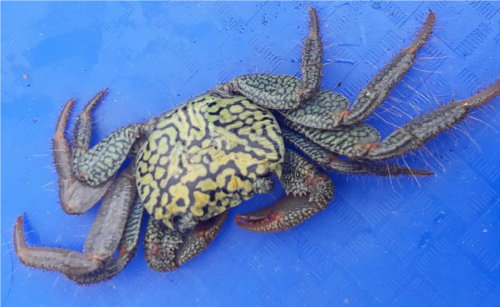
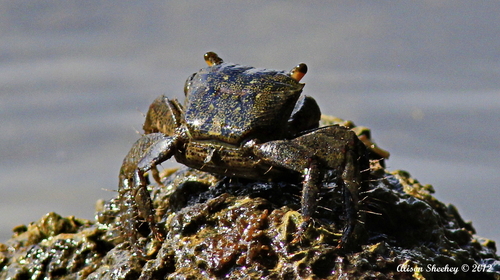
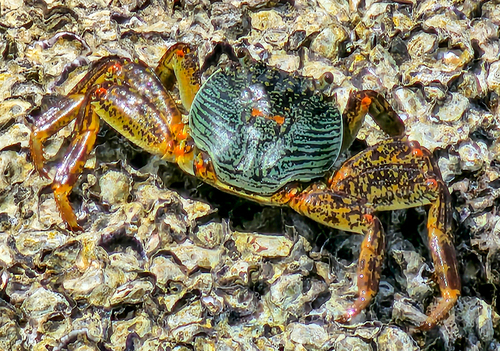
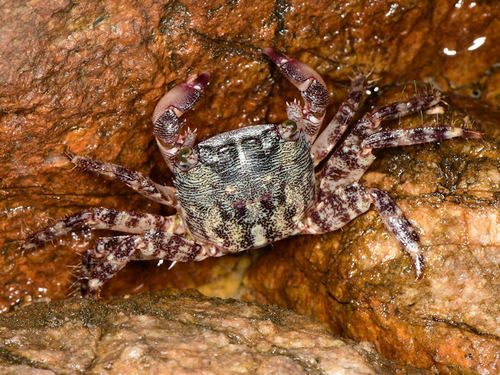
Pachygrapsus marmoratus (Fabricius, 1787) has a square carapace 22–36 millimetres (0.87–1.42 in) long. The carapace is dark violet brown with yellow marbling. It can be told apart from two related Pachygrapsus species found in the Mediterranean Sea — Pachygrapsus maurus and Pachygrapsus transversus — by the presence of three teeth on each side of its carapace. This species moves very quickly, and uses this speed to dart into crevices, which makes it difficult to catch.
Pachygrapsus marmoratus is widespread across Southern Europe, from the Black Sea to the Moroccan coast. It also occurs along the Atlantic coasts of Portugal, Spain, and France. As early as 1996, individuals were observed as far north as Southampton in the English Channel. This northward range expansion may be caused by warming surface waters.
Pachygrapsus marmoratus is an omnivore, but not an opportunistic feeder: regardless of how abundant algae or animals are in its habitat, it consumes the two in similar proportions. Its preferred prey animals are mussels, limpets, and conspecifics (members of its own species). When attacking the limpet Patella depressa, Pachygrapsus marmoratus uses a consistent hunting method that is usually unsuccessful. On more sheltered shores, P. marmoratus eats fewer mussels, and makes up for this by consuming more barnacles. A known predator of Pachygrapsus marmoratus is the musky octopus, Eledone moschata. The larvae of P. marmoratus are planktonic and can survive for up to 31 days. This long planktonic stage leads to high levels of gene flow between populations, and lets the species rapidly colonize new areas.