About Pachycephala inornata Gould, 1841
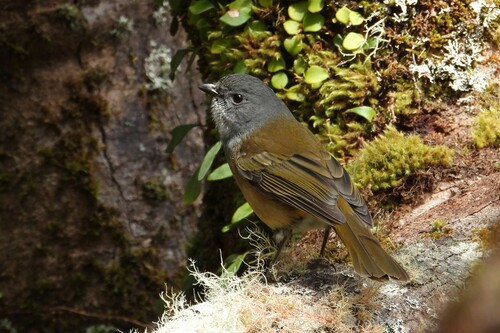
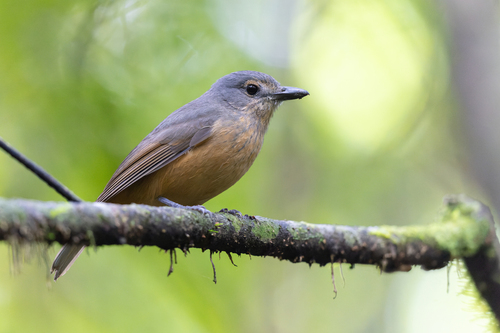
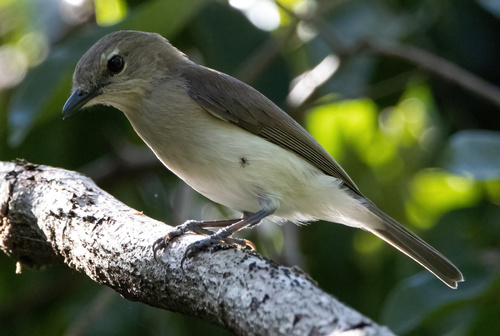
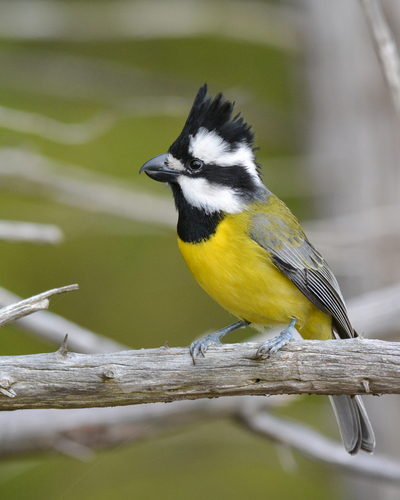
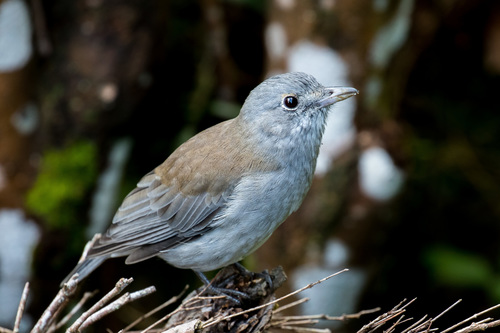
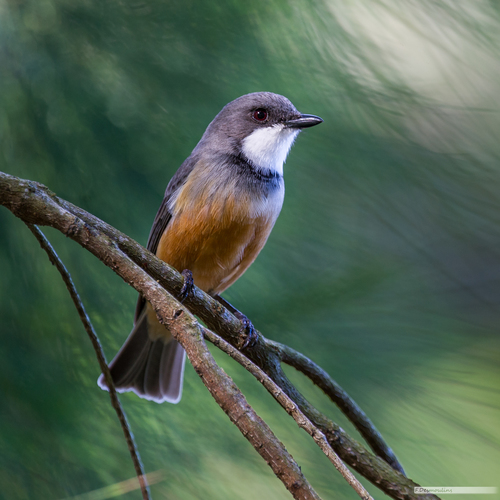
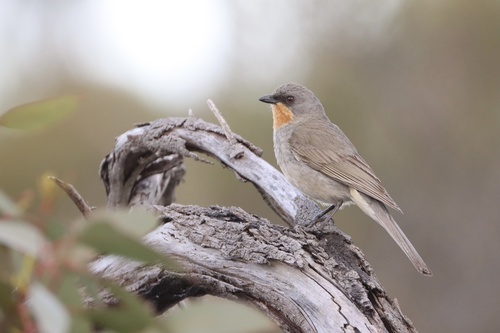
This species, Pachycephala inornata (commonly known as Gilbert's whistler), was first described by Gould in 1841. Adult male Gilbert's whistlers weigh 29.8–32.5 g, and develop rufous-coloured chins and throats starting from their third year of life, a trait they share with the red-lored whistler, their most likely closest relative. The two species can be easily differentiated by the colour of their lores: lores are black for Gilbert's whistler, and red for the red-lored whistler. Female Gilbert's whistlers weigh 23.5–32.2 g, have a pale grey throat, a white ring around the eye, and may have lightly streaked underparts. Both sexes of Gilbert's whistler are uniformly brownish-grey, with a red iris and a black stubby bill that measures 17–18 mm in length. Juvenile Gilbert's whistlers, which weigh an average of 30.9 g, are darker than adults, have brown tinges to their plumage, and show dark streaks on the breast and belly. Immature Gilbert's whistlers are very similar in appearance to adult females, differing only in having a brown bill and dark brown iris. Where their ranges overlap, care must be taken not to confuse female and immature Gilbert's whistlers with female golden or western whistlers. At one point, Gilbert's whistler was split into two subspecies: Pachycephala inornata inornata found east of the Flinders Ranges with greyish white underparts, and Pachycephala inornata gilberti found to the west with cinnamon and buff underparts. This plumage variation is now considered to be clinal. A 2020 study by Onley, Gardner and Symonds tested whether climate change had caused larger appendages in whistlers, consistent with Allen's rule, using museum specimens collected between 1915 and 2013. The study found that Gilbert's whistler body size increases at higher latitudes, which follows Bergmann's rule. Gilbert's whistler inhabits semi-arid tall mallee with sparse shrubby understorey, prickly Acacia thickets, and Casuarina woodlands. It can also be found in Melaleuca thickets, and occasionally occurs in taller eucalypt woodlands or forests. A 2017 study examined the effect of bushfires and prescribed burns on the distribution of 12 threatened bird species, and predicted that Gilbert's whistler favours habitat that was burnt approximately 30 to 60 years prior. Habitat that is burnt more frequently, or that has not been burnt for more than 60 years, does not readily suit the species. The distribution of Gilbert's whistler is scattered across semi-arid areas of southern Western Australia, South Australia, northwest Victoria, and central west New South Wales. No large-scale movements have been recorded for this species, which is thought to be resident or sedentary with a high degree of site fidelity. As a result of this limited movement, the species is sensitive to habitat disturbance. A study by Murphy on the conservation value of small New South Wales woodland remnants found that the distribution of Gilbert's whistler in this region is largely restricted to remaining patches of original vegetation. A bird banding group project at Charcoal Tank Nature Reserve in central west New South Wales recorded the local extinction of Gilbert's whistler in this 86-hectare (210-acre) patch of remnant vegetation during the 'Big Dry' of 2000–2001. This local extinction, a classic example of 'Extinction Debt', was mainly attributed to habitat fragmentation, 100 years of agricultural land clearing, introduced predators, increased competition from other native species, and drought periods worsened by climate change. Additional details on these threats are outlined on the NSW Government species profile page.