About Pachliopta hector (Linnaeus, 1758)
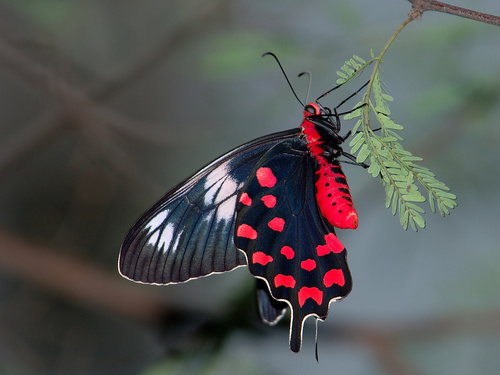
Pachliopta hector, first described by Linnaeus in 1758, has the following physical characteristics. On the male's upperside, the base color is black. The forewing has a broad, interrupted white band that starts from the subcostal nervure opposite the origin of veins 10 and 11, extends obliquely to the tornus, and also has a second short pre-apical band of similar appearance; both bands are made up of detached, irregularly indented broad streaks located in the interspaces. The hindwing has a distal series of seven crimson spots that is strongly curved toward the posterior, followed by a subterminal series of crimson lunules. The cilia are black, alternating with white. On the underside, the forewing is dull brownish black, and the hindwing is black; all markings match those on the upperside, but the crimson spots and crescent-shaped markings on the hindwing are larger. The antennae, thorax, and the base of the abdomen on the upper side are black; the head and the rest of the abdomen are bright crimson; on the underside, the palpi, and the sides of the thorax and abdomen are crimson. The female is similar in appearance to the male, but its discal series of spots and subterminal lunules are much duller, being pale crimson sprinkled with black scales; in some specimens, the anterior spots and lunules are almost white, with only a faint crimson tint; on the upper side of the female's abdomen, black color extends further toward the apex. No geographic races of this species have been described. Pachliopta hector is found in Pakistan, India, Sri Lanka, the Maldives, and possibly along the coast of western Myanmar. Within India, it occurs in the Western Ghats, southern India (specifically Tamil Nadu and Kerala), and eastern India (specifically West Bengal and Odisha). It is only a straggler in the Andaman Islands. This butterfly lives comfortably in both jungle habitats and open country. During the dry season, it can be found at elevations up to 8000 feet, or 2400 meters, in South India, and it is present year-round at lower elevations. Higher population numbers of Pachliopta hector are generally observed between August and November, and also between April and June. This species can breed up to seven times per year, and the development period from egg to adult takes only 39 to 47 days. The larvae of Pachliopta hector develop on various species in the genus Aristolochia, including Aristolochia indica, Aristolochia bracteolata, and Thottea siliquosa. This species is unpalatable to predators because it sequesters chemical compounds including aristolochic acid from its host plants during the larval stage.