About Pachliopta aristolochiae (Fabricius, 1775)
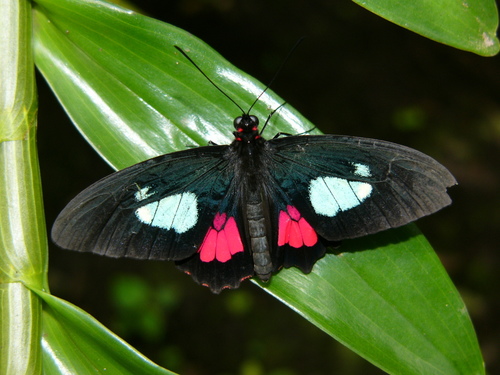
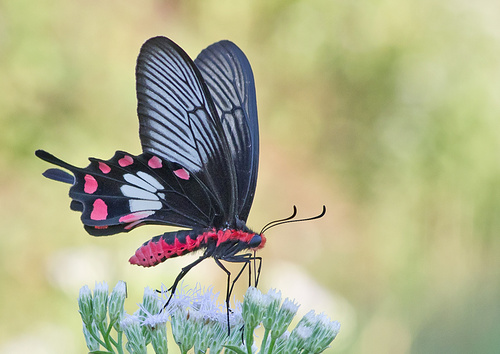
This species, Pachliopta aristolochiae (Fabricius, 1775), has the following description. For males, the upperside of the body is velvety black. On the forewing, well-defined pale streaks run along the veins in the discal area, and these streaks do not extend to the broadly velvety black terminal margin. Streaks located beyond the end of the forewing cell extend inward into the cell's apex. The hindwing has elongated white discal markings in interspaces 2 to 5, beyond the cell. In specimens from dry weather, these markings are very short and do not come close to reaching the bases of the interspaces. Beyond these white markings, there is a curved series of subterminal crescent-shaped markings in interspaces 1 through 7; these markings are dull crimson and speckled with black scales. The marking in interspace 1 is large, irregular, and diffuse, with a white inner margin. On the underside of males, the base color and overall pattern are similar to the upperside, but the red subterminal spots on the hindwing are much brighter. These underside spots are not speckled with black scales, are more sharply defined: the front four are roughly square-shaped, the next two are crescent-shaped, and they may sometimes also be square-shaped. The spot in interspace 1 is triangular and pointed. Antennae, thorax, and the upper surface of the abdomen up to the pre-anal segment are black. The head, upper sides of the prothorax, and the entire undersides of both the thorax and abdomen are vermilion red. The anal segment is also vermilion red. Females are similar in appearance to males, differing only by having comparatively broader wings, a difference that is most noticeable in the forewing. This butterfly is widely distributed across Asia. Its range includes Afghanistan, Pakistan, India (including the Andaman Islands), Nepal, Sri Lanka, Myanmar, Thailand, only south-western Okinawa in Japan, Laos, Vietnam, Cambodia, the Nicobar Islands, peninsular and eastern Malaysia, Brunei, Palawan and Leyte in the Philippines, Indonesia, Bangladesh, and Taiwan. In China, it occurs in southern and eastern China, including Hainan and Guangdong province, as well as Hong Kong. In Indonesia, it is found in Sumatra, Nias, Enggano, Bangka, Java, Bali, Kangean, Lombok, Sumbawa, Sumba, Flores, Tanahjampea, and Kalimantan. This species is an adaptable generalist that has adapted to a wide range of habitats, and it can be found gathering in groups at lower elevations. In the Western Ghats and south Indian hills, it occurs up to 2,400 metres (8,000 ft) above sea level. At the eastern end of the Himalayas, it is found up to 1,500 metres (5,000 ft), while it only reaches up to 910 metres (3,000 ft) in the north-western Himalayas. It is a common visitor to Indian gardens, and can even be found in densely populated urban areas. The larvae of Pachliopta aristolochiae feed on creepers and climbing plants in the genus Aristolochia, of the family Aristolochiaceae. The larvae sequester toxins such as aristolochic acid in their bodies, which makes adult butterflies toxic to vertebrate predators including birds and reptiles. Braconid wasps that parasitize the caterpillars have apparently co-evolved with this butterfly, and are not affected by these toxins. Recorded larval food plants are Aristolochia bracteolata, Aristolochia indica, Aristolochia tagala, Aristolochia griffithi, Aristolochia leuconeura, and Thottea siliquosa.