About Ozothamnus scutellifolius Hook.fil.
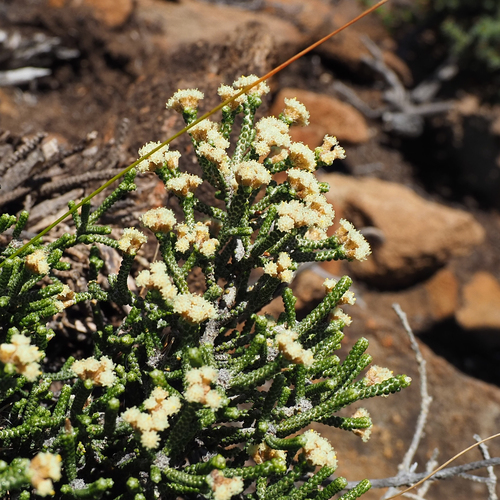
Ozothamnus scutellifolius Hook.fil. is a small shrub that grows 0.3–1 m tall and approximately 0.5–1.5 m wide. It has a dense branching habit, and its branches appear white because they are densely covered in tiny, matted hairs, a trait called tomentose. The small leaves, which measure 0.4–1.5 mm in diameter, are circular or dome-shaped and tightly pressed against the stems, giving the species its distinct appearance. The upper leaf surface is often smooth and shiny, and occasionally has sparse, small woolly hairs. Leaf edges roll under, hiding a lower leaf surface that is lightly tomentose. The inflorescence is a small cluster of 3 to 5 terminal flower heads, which are less than 5 mm long and 2–3 mm across, holding 15 to 20 pale yellow or white florets. The multiple layers of bracts are brownish, thin and dry; the innermost bracts are alternately white-tipped or clear. Flowering takes place from September to November. Fruits are dry, one-seeded fruits with leathery or membranous skins or shells that stay closed when mature; this is a type of achene called a cypsela. The cypselae of Ozothamnus scutellifolius have tiny, rounded bumps and a tuft of hooked bristles. This species can be mistaken for other members of Asteraceae: Ozothamnus hookeri, Ozothamnus reflexifolius, and Olearia lepidophylla, because all have similar-looking tomentose stems with small bright green leaves. O. hookeri and O. reflexifolius have very little overlapping distribution with O. scutellifolius, which lowers the chance of misidentification. Though Olearia lepidophylla grows in similar habitats, it has single white terminal flowers, unlike the clusters of yellow or white terminal flowers found in O. scutellifolius. Ozothamnus scutellifolius is a hardy shrub endemic to dry eucalypt woodland with well-drained soils in eastern Tasmania. Its distribution stretches from St. Helens at the northern end, south along the east coast and southern midlands to Cape Bruny on Bruny Island, with very small isolated populations scattered across the Central plateau and the northern coast. Even though it is locally abundant, it is classified as an endangered species due to its restricted global distribution. Tasmania has strong variation in annual rainfall: the west receives an average of approximately 2000 mm per year, while the midlands and drier parts of the east and southeast receive only around 600 mm. Morphological adaptations to drought-prone conditions are visible in the characteristic small, scale-like leaves of O. scutellifolius, which have rolled edges, and abundant tomentose lower leaf surfaces and stems. These features, along with thickened leaf cuticles, greatly reduce evaporation and maximise water retention to help the species survive the dry conditions of eastern Tasmania. O. scutellifolius can grow in a wide range of soil types, from loamy and fertile to low-phosphorus, nutrient-poor, or sandy soils. Little readily available information exists about the ecological succession of this species. However, its exposure and drought-adapted traits, plus its placement in the Asteraceae family, suggest it tends to be an early successional species in disturbed and exposed sites. This tendency is supported by the semi-frequent fire events common to Tasmania's dry woodlands.