About Ozothamnus leptophyllus (G.Forst.) Breitw. & J.M.Ward
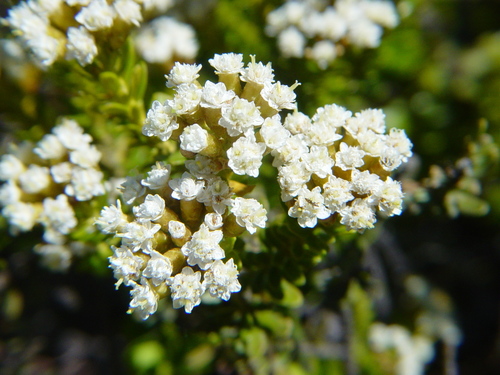
Ozothamnus leptophyllus (G.Forst.) Breitw. & J.M.Ward is a dicot bushy shrub. Its foliage is gray or yellow-green; it can grow up to 5 meters tall, and most individuals reach 2 to 3 meters in height. The plant's stems are covered in dense woolly hairs, a trait called tomentose. It has simple broad leaves arranged alternately along stems, and is a self-supporting plant that grows vertically on its own. Young leaves are slightly sticky; mature leaves range from hairless to moderately hairy, with a covering of moderate amounts of white hair. Leaves are spatulate in shape and grow up to 3 millimeters wide. The plant's branchlets are slender and hairless. Petioles, the stalks that connect leaves to stems, wrap around branchlets, and leaves are arranged in groups of three to four along the stem. Flowers are mostly white, with occasional pink or red coloring on the buds. Each capitulum holds 4 to 15 florets. Ozothamnus leptophyllus is endemic to New Zealand, while the wider Ozothamnus genus is distributed globally. This species occurs across all of New Zealand, including the North Island, South Island, Stewart Island, and Auckland Island. It is a common species, and as of 2012, its conservation status is Non Threatened. This species grows in habitats ranging from coastal to subalpine shrubland and scrub. It is found in open areas including erosion gutters and avalanche chutes, and grows best on land where ground cover has been removed. It can adapt to many different habitat types, which contributes to its status as a common plant across New Zealand, especially in open areas. This species typically flowers between December and March, though botanist Allan recorded flowering occurring between November and February. Fruits develop shortly after flowering and remain on the plant until April. Seed ripening usually starts in late January, peaks in March, and most seeds are wind-dispersed during March. This plant's branches form growth rings that allow scientists to determine the plant's age, but these rings do not become visible until branches are approximately eight years old. Leaves of this species show strong antiviral activity against polio and herpes, and also have weaker antifungal and antimicrobial properties. Because it is fast growing, easy to cultivate, and tolerant of a wide range of conditions, it has grown in popularity for revegetation projects and cultivation. It is particularly well-suited for sand dune restoration.