About Ozothamnus ferrugineus (Labill.) Sweet
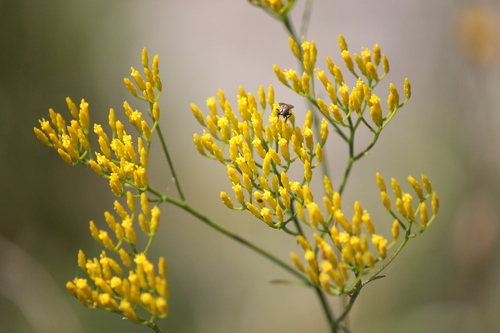
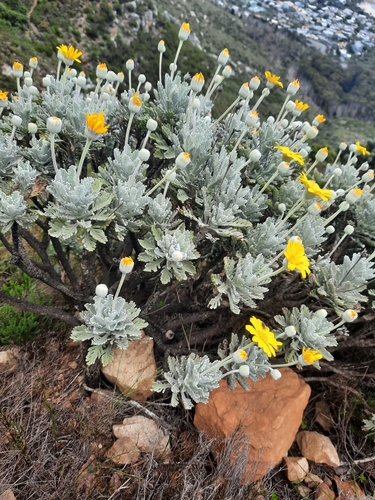
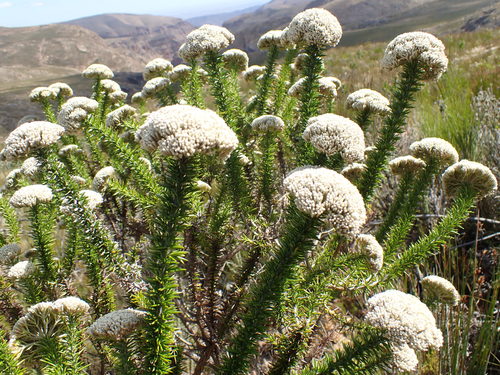
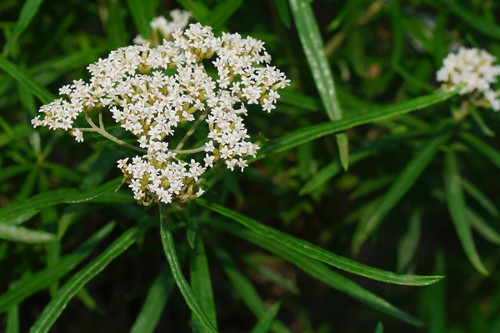
Ozothamnus ferrugineus (Labill.) Sweet is a medium to large erect, much-branched, aromatic woody shrub with an open growth habit. It typically grows 2 to 3 metres tall, and reaches 1.5 to 3 metres wide. Fine hairs grow in lines along its stems, and crowded leaves extend alternately from cottony branchlets. Young leaves are light green and sticky to the touch; as they mature, they darken to a deeper green, with a glabrous, resiny upper (adaxial) surface, and a lighter grey, densely hairy lower (abaxial) surface with a glabrescent midrib. Mature leaves are flat, fine, spreading, 2 to 7 centimetres long, linear to lanceolate in shape, with pointed tips and slightly wavy margins. Flowering occurs during the summer months. The inflorescence of O. ferrugineus closely resembles cauliflower heads, and is made up of 80 to 300 densely packed small white daisy-like florets. These florets are arranged in 5 to 6 compact, hemispherical, corymbose terminal clusters. Each individual flowerhead is cylindrical to bell-shaped, 3 to 5 millimetres long with a diameter of 1 to 4 millimetres, and remains on the shrub for long periods. 14 to 18 small bracts lie appressed to the base of each flowerhead. The lower half of the inner bracts is translucent, while the upper half is opaque white. Outer bracts range in colour from golden brown to green. After flowering, O. ferrugineus produces a cypsela, a fruit type typical of the Asteraceae family. This is a dry, single-seeded fruit that is narrow to ovoid in shape, and measures 1 millimetre long. The calyx is modified into a pappus made of 2 to 3 millimetre long bristles, which helps the seed disperse via wind. Ozothamnus ferrugineus is a common and widespread middle understory species in open forests and scrubland across south-eastern Australia. It occurs from coastal swampland and scrub up to elevated ranges and tablelands throughout Victoria, South Australia, New South Wales, and Tasmania, and often grows persistently along roadsides. It prefers well-drained, moist sites, and is typically one of the first species to regenerate after fire or other disturbances. When above-ground parts are killed or severely damaged by disturbance including fire, Ozothamnus ferrugineus can resprout. Even though its foliage is highly flammable, the species survives average-severity bushfires, and is regularly one of the first species to become established after a disturbance event. Its seeds are wind-dispersed, using the pappus to travel. The main form of regeneration for O. ferrugineus is reproduction from seed. Seeds should be directly sown in early winter, because slow-growing seedlings can be vulnerable to spring drought. The plant is long-lived, and its flowers are also long-lasting. It prefers growing in full sun to semi-shade.