About Oxyuranus scutellatus Peters, 1867
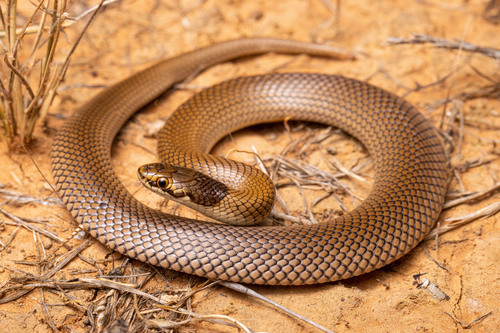
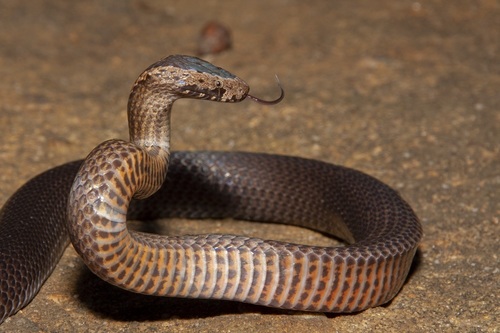
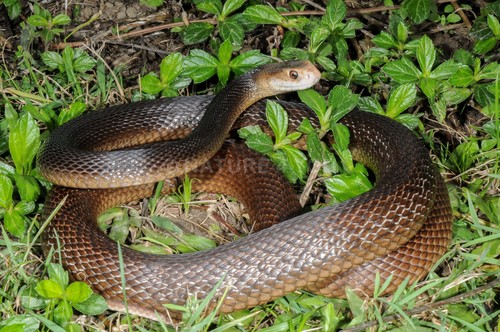
This species, commonly known as the coastal taipan, is the second-longest venomous snake in Australia, ranking only behind the king brown snake (Pseudechis australis). Adult coastal taipans typically reach sexual maturity at a total length (including the tail) of around 1.2 m (3.9 ft). More mature adults grow to between 1.5 and 2.0 m (4.9 and 6.6 ft). Other taipan species, including the inland taipan, reach broadly similar sizes, but tend to have a slightly smaller average size. An average coastal taipan with a total length of 2.0 m (6.6 ft) weighs around 3.0 kg (6.6 lb). According to the Queensland Museum, the longest recorded total length for a confirmed coastal taipan specimen is 2.9 m (9.5 ft), with a weight of 6.5 kg (14 lb). While exceptionally rare, it is widely believed that much larger specimens exist, including individuals reaching up to 3.3 m (11 ft). O. scutellatus has a long, narrow head with an angular brow, and its face is lighter in colour than the rest of the body. Its body is slender, and body colouration varies between individuals. It is often uniformly light olive or reddish-brown, but some specimens range from dark gray to black. Body colour lightens along the sides, and the ventral (belly) side is usually creamy-white to pale light yellow, often marked with orange or pink flecks. Individual coastal taipans undergo seasonal colour changes, darkening in winter and fading to a lighter shade in summer. Their eyes are large, round, and light brown or hazel in colour, with large pupils. As a large, brownish snake, the coastal taipan resembles the eastern brown snake (Pseudonaja textilis), northern brown snake (P. nuchalis), and king brown snake. However, it can be distinguished from these similar species by its larger head, narrow neck, and light-coloured face and snout; in the other similar species, the head and neck are the same width. The coastal taipan is classified as a least-concern species by the International Union for Conservation of Nature. It occurs in northern Australia and southern New Guinea. In Australia, its range extends from north-western Western Australia through the Northern Territory, across Cape York Peninsula, and south along eastern Queensland into northern New South Wales, reaching as far south as Grafton. The coastal taipan is not found in regions where the maximum winter temperature is below 20 °C (68 °F). The second subspecies, O. s. canni, lives across the full island of New Guinea, with higher populations found in Papua New Guinea. The coastal taipan inhabits a variety of habitats, all within warm, wetter, temperate to tropical coastal regions. It can be found in monsoon forests, wet and dry sclerophyll forests, woodlands, and both natural and artificial grassy areas, including grazing paddocks and disused rubbish tips. It appears to have become more common since the cane toad was introduced to the region in 1935. It is unclear whether this increase comes from reduced competition (as other large venomous snakes have declined after being poisoned by cane toads), or from an increased rodent food supply. The species has adapted well to sugarcane fields, where it thrives feeding on the local rodent population. In Far North Queensland's Cape York Peninsula, it is usually found in open woodland areas. It also favours thickets of the introduced plant Lantana. The coastal taipan shelters in abandoned animal burrows, hollow logs, and piles of vegetation and litter. The coastal taipan's breeding season runs from August to December. It is oviparous, laying a clutch of 7 to 20 eggs per breeding cycle. The eggs take 60 to 80 days to hatch, and newly hatched snakes measure between 30 and 34 cm (12 to 13 in) in length. Young coastal taipans grow quickly, averaging 6.7 cm (2.6 in) of growth per month, and reach a length of 1.0 m (3.3 ft) within their first year. Males reach sexual maturity at a length of 80 cm, which they typically achieve around 16 months of age. Females become able to breed when they reach around 100 cm in length, which usually occurs around 28 months of age.