About Oxynoe viridis (Pease, 1861)
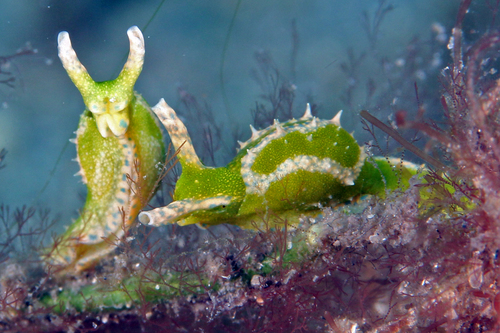
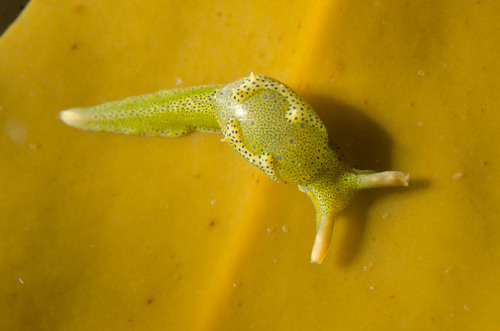
Description: The body of Oxynoe viridis is oval or ovate, with an elevated dorsal region. Its lateral lobes have a regular shape, with convex outer edges that do not meet. The tentacles are well-developed, grooved, and truncated; the eyes are embedded immediately behind the tentacles. The foot is linear and adapted for clasping seaweed, and the entire upper surface has a variable number of cirrigerous appendages. The tail is long, compressed, and ends in a lance-shaped point. Coloration: The body is grass green, mottled with darker green. It is sometimes dotted minutely with brown, or may have a few blue spots with black margins along the edges of the lateral lobes and on the neck. The shell is thin, pellucid, fragile, and white, with a slight convolution, fine oblique striae, and a slight inflation on the left side. The aperture is large and widely open. The outer lip is separated from the apex, extends only very slightly posteriorly, and is truncated. The inner lip has a slight callus. Distribution: This species is found in the Philippines, Australia, Indonesia, Egypt, Taiwan, and Turkey. The type locality for the species was originally given as "Sandwich Islands", which are now known as the Hawaiian Islands.