About Oxynoe antillarum Mörch, 1863
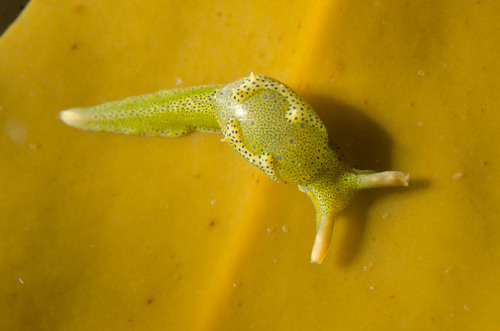
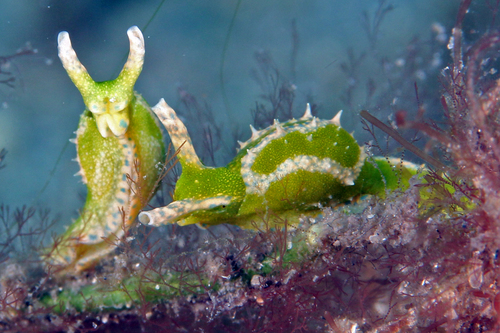
This species has a characteristic mottled white pattern, and its body is covered with translucent white spots. A mottled white band extends along the sides of the head, around the edge of the parapodia, and along the edge of the foot. The body is green, oval, and closely dotted with green. It has a very long, narrow tail with a wide longitudinal white dorsal band. Tentacles and the sides of the head are white, with relatively spaced green dots arranged in series. Epipodial lobes have acute, conical, closely spaced warts; the edge of the epipodial lobes is white with irregular green dots. The narrow, yellowish sole of the foot has a row of regular, closely spaced green dots along its margin. The shell is involute, ovate, and hyaline-white. It is swollen above, very slightly contracted immediately below the vertex, and shining, with some irregular growth wrinkles. The spire is concealed. The suture forms a deep lunate incision. The aperture is very large, broadly ovate below and narrow above. The outer lip is sinuous, and extended forward above. The shell measures 6 to 6.25 mm in height and 4.5 mm in width. The type locality of this species is Saint Thomas, U.S. Virgin Islands.