About Oxymeris crenulata (Linnaeus, 1758)
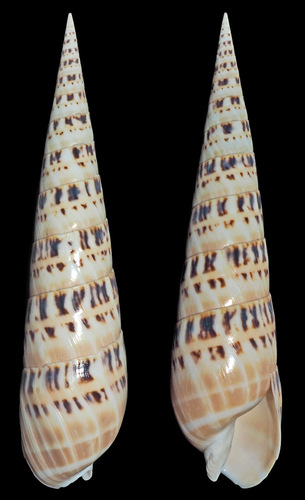
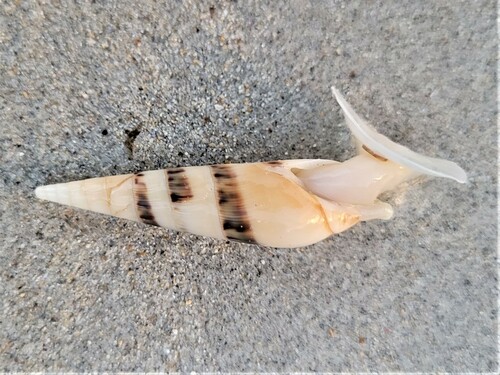
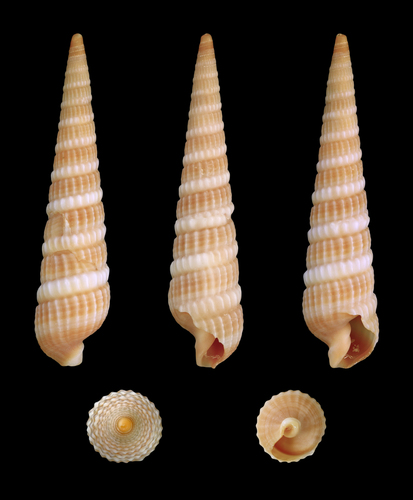
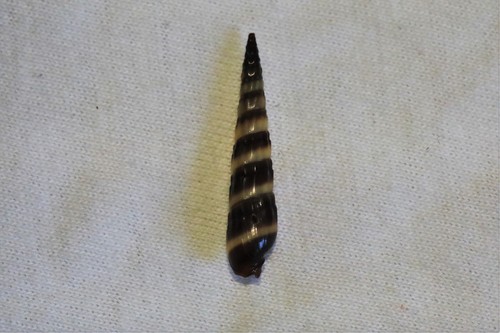
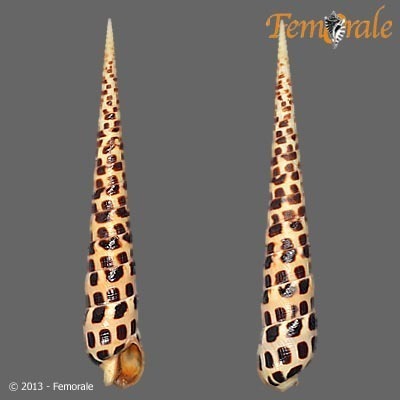
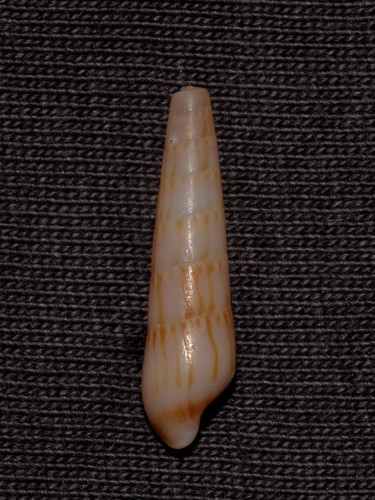
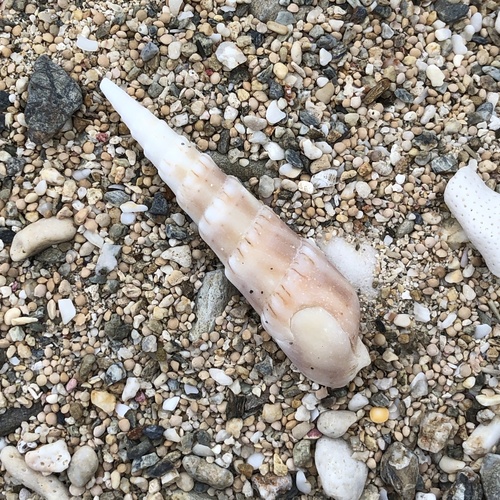
Description: The adult shell of Oxymeris crenulata ranges in size from 48 mm to 154 mm. The shell is ovate and conical, and its base color is whitish, ashy, or reddish; it often has two brown bands that are sometimes interrupted. The spire is made of seven or eight distinct whorls, which are flattened on their upper side. These whorls have longitudinal, nearly perpendicular folds, and these folds are crossed by striae that are only visible in the gaps between the folds, except towards the base of the shell and on the whorls near the top of the spire. The upper edge of each whorl is flattened, and bordered by rounded tubercles. A deep stria runs below these tubercles, separating them from the longitudinal folds. The ovate aperture is whitish, and is narrowed at the top by a transverse fold of the left lip. The outer lip is notched at its upper edge, and has many transverse striae on its inner surface. The left lip is smoothed and flattened at its summit. From its middle to its base, it forms a fairly thick, projecting keel-shaped callosity. This species has a large number of varieties. In young specimens, the shell color is deeper, the transverse brown bands are more distinct and visible across all whorls, and the shell is proportionally more globular in shape. Other specimens have a uniform shell color, strongly canaliculated whorls, and more closely spaced longitudinal folds. Distribution: This species occurs in the Red Sea, in the Indian Ocean off Aldabra, Chagos, Madagascar, the Mascarene Basin, and Tanzania, and in the Pacific Ocean off Mexico.