About Oxyjulis californica (Günther, 1861)
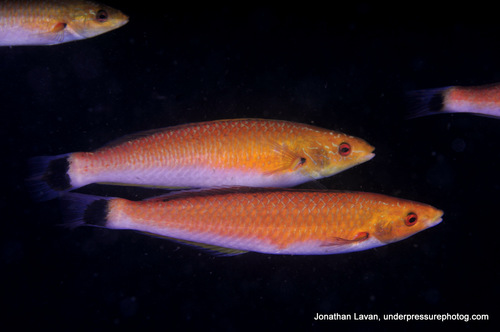
Oxyjulis californica is a species of wrasse native to the eastern Pacific Ocean along the coasts of California and Baja California. Its distribution ranges from Salt Point in Sonoma County, California, to southern central Baja California, near Cedros Island. It is a very common species; its common name in Spanish is señorita. This fish can reach a maximum total length of 25 cm (9.8 in). It has a fusiform, frequently described as "cigar-shaped", body. Its dorsal side is brown or shiny bronze, its sides are orange, and its ventral side is paler. The base of its tail fin is mostly covered by a large black or chocolate brown spot. It has a small mouth and protruding "buck teeth", which it uses to scrape tiny invertebrate prey off kelp. This species lives in near-coastal marine habitats, especially kelp forests and reefs. While it has been observed at depths up to 73 m (240 ft), it typically lives at depths of 20 m (66 ft) or shallower. It may swim in small schools, but when threatened, it usually retreats to the seabed and digs into the substrate to hide. At night, it rests on the bottom, burrowing backwards so only its head remains exposed above the substrate. The diet of Oxyjulis californica consists mostly of invertebrates, including marine worms, bryozoans, crustaceans, dove snails, limpets, fish larvae, and squid. It may also consume small amounts of seaweed. Additionally, it feeds on the ectoparasites of other fish. The señorita is a cleaner wrasse, meaning it grooms parasites and other unwanted materials off the bodies of other fish. It removes and eats ectoparasites such as bacteria, copepods, and isopods, and parasites can make up around half of its total food intake. Sometimes, when a señorita begins cleaning one client fish, a crowd of other fish will gather around to also receive cleaning service. Fish species that seek out the señorita for grooming include the bat ray (Myliobatis californica), giant sea bass (Stereolepis gigas), kelp bass (Paralabrax clathratus), jacksmelt (Atherinopsis californiensis), topsmelt (Atherinops affinis), sargo (Diplodus sargus), blacksmith (Chromis punctipinnis), garibaldi (Hypsypops rubicundus), opaleye (Girella nigricans), halfmoon (Medialuna californiensis), and mola (Mola mola). These client fish use specific behaviors to solicit cleaning. Garibaldi extend their gill slits to give the señorita access to parasites on their gills. Blacksmith point their heads downward to encourage the cleaner, and multiple blacksmith will often gather to compete for the señorita's attention; they may even block its escape if it tries to leave. Opaleye are usually constantly swimming, but will stop and hold still when they encounter a señorita. Kelp bass, which are predators of small fish, will often refrain from eating the señorita and allow it to clean them. Even though the señorita often cleans large predatory fish, cleaning is not always safe for it. It has been found in the diets of kelp bass, bocaccio (Sebastes paucispinis), and starry rockfish (S. constellatus), but it is not eaten as often as expected given how frequently it comes into close contact with these predators, leading to suggestions that it may be unpalatable. Confirmed predators of this fish include Brandt's cormorant (Phalacrocorax penicillatus) and the California sea lion (Zalophus californianus). The reproductive biology of Oxyjulis californica is not well understood. Some sources suggest it may be a protogynous hermaphrodite, where females can change sex to become male, while other sources dispute that this occurs in the species. Spawning takes place from May through August, and the eggs are pelagic, floating freely in the water column. This fish tends to return to preferred home locations; in one experiment, señoritas were caught and released some distance away from their original ranges, and most were able to find their way back. Commercial and recreational fishermen generally do not target this species, and it is often considered an annoyance because it steals bait from fishing hooks. While it is technically edible, it has no value as a food fish.