About Oxycirrhites typus Bleeker, 1857
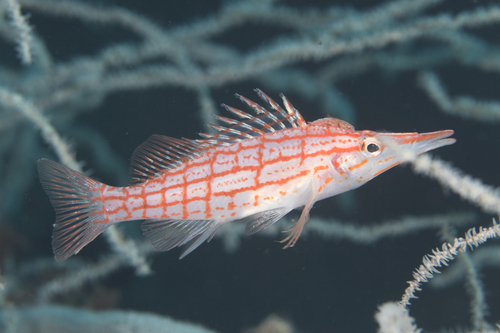
Oxycirrhites typus Bleeker, 1857, commonly called the longnose hawkfish, can be distinguished from all other hawkfish species by its elongated snout: the snout's length is roughly equal to half the total length of the head. The canine teeth in its jaws are uniform in size, and only slightly larger than the inner band of villiform teeth. Its dorsal fin has 10 spines and 13 soft rays, while its anal fin has 3 spines and 7 soft rays. This species reaches a maximum total length of 13 centimetres (5.1 in). Each dorsal fin spine has a tuft of cirri at its tip. The overall body colour is whitish, overlaid with a grid of red horizontal and vertical lines. The longnose hawkfish has a wide distribution across the Indo-Pacific region. In the Indian Ocean, it occurs from the Red Sea, along the coast of East Africa south to northern Mozambique and Madagascar, spanning across the Indian Ocean into the Pacific. In the Pacific, it ranges as far east as the Hawaiian Islands and the Society Islands in French Polynesia, north to Japan, and south to Australia. In Australia, it can be found southwest of Barrow Island and at Scott Reef in Western Australia, at Ashmore Reef in the Timor Sea, from Lizard Island south to Escape Reef in Queensland, and also at Christmas Island and the Cocos (Keeling) Islands. In the eastern Pacific Ocean, it is found from the southern tip of Baja California and the central Gulf of California south to Colombia, and also occurs around the Revillagigedos Islands, Galapagos Islands, Cocos Island, and Malpelo Island. This species lives at depths between 10 and 100 m (33 and 328 ft). It inhabits steep outer reef slopes exposed to strong currents, where it lives among large gorgonians and black corals.