About Oxybelis aeneus (Wagler, 1824)
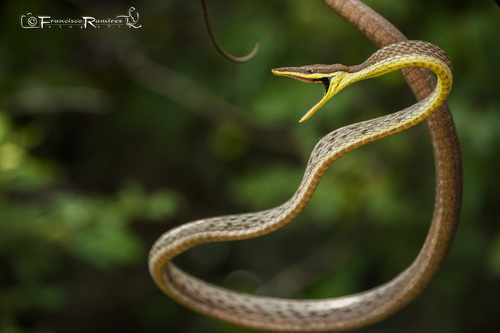
Oxybelis aeneus (Wagler, 1824) is an extremely slender snake with a maximum total length (including a long tail) of 1.9 meters (6.2 feet). Its dorsal color ranges from gray to brown, and it has a yellow underside. The body is laterally compressed, and it has a prominent snout that is more than twice as long as the eye's diameter. This species has 1 preocular scale, 2 postocular scales, 1 anterior temporal scale, and 2 posterior temporal scales. It lacks a loreal scale, and has 8–10 upper labial scales. Its smooth dorsal scales are arranged in 17 rows at midbody. It has 173–205 ventral scales, and 150–188 divided (paired) subcaudal scales. The anal plate is divided in specimens from Arizona, but is entire in specimens from South America. Oxybelis aeneus occurs from the Atascosa, Patagonia, and Pajarito mountains of southern Arizona in the United States, through Mexico, to northern South America and Trinidad and Tobago. In Arizona, this species is only found in Madrean Evergreen Woodland communities and the upper portions of neighboring semidesert grassland habitats. It is most often found in trees or shrubs on open, steep, grassy slopes, but also occurs in wooded canyons, particularly those with dense vegetation. Oxybelis aeneus is oviparous. Recorded clutch sizes range from 3 to 6 eggs. In Arizona, hatching takes place in September.