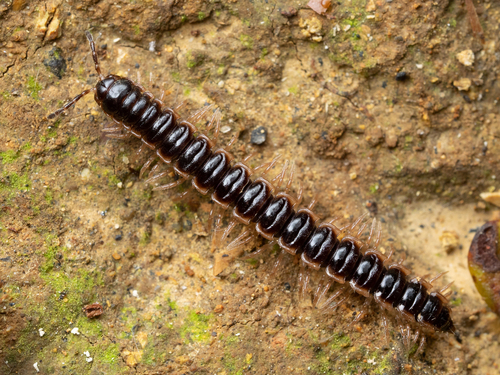
About Oxidus gracilis (C.L.Koch, 1847)
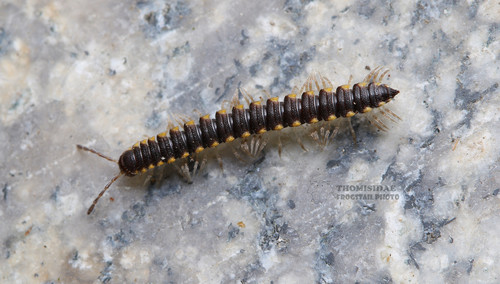
Oxidus gracilis, commonly called the greenhouse millipede or flat-back millipede, has a flattened body with a hard exoskeleton. It is brown, with pale cream-colored legs and paranota, which are lateral keels extending from each body segment. Adult greenhouse millipedes reach 18 to 23 mm (0.71 to 0.91 in) in length and 2 to 2.5 mm (0.079 to 0.098 in) in width. Fully grown individuals have around 15 body segments and 60 legs. Each body segment bears a transverse groove along its dorsal section, a trait characteristic of most paradoxosomatids. This millipede species is completely blind, lacking eyes entirely, and relies on its antennae as the main sensory organ for navigating its habitat. It gets its common name from thriving best in greenhouse conditions.
Oxidus gracilis originally occurs natively in Asia, and it is now an invasive species in the Americas and Europe. It originated in the tropics, and has spread to southern and western U.S. states as well as Northern Europe, and can survive in habitats ranging from tropical rainforests to temperate climates such as that of the United Kingdom. It prefers cool, moist environments, and requires sheltered, mineral-rich surfaces covered with organic matter to thrive and reproduce. It is commonly found under stones or rotting logs in overgrown areas. It often invades man-made structures that meet its habitat requirements, including greenhouses, garages, and basements. Its tendency to breed rapidly and outgrow natural habitats contributes to these invasions of human structures. In the ecosystems it inhabits, Oxidus gracilis plays an important role in nutrient cycling and decomposition. Its adaptability to varied environments and ecological importance make it a notable resident of both natural and urban landscapes.
Few specific details about greenhouse millipede reproduction have been documented by researchers, because millipede reproduction as a whole is difficult to study. What is known is that this species reproduces sexually, with reproductive anatomy unique to the species. Females reach physical sexual maturity at 6 to 7 months old, when they are ready to mate. Males use a "lock and key" method of fertilization. Males have specialized legs called gonopods located around the seventh body segment, which act as sexual appendages to hold the female stable during mating, increasing the success of the process. After the female’s eggs are fertilized, she releases a sticky substance that seals her vulvae closed, preventing premature release of the eggs. Females lay 40 to 50 fertilized eggs after mating. Eggs develop over 6 to 8 weeks in cool, dark, moist soil—this environment provides developing larvae with access to necessary nutrients and protection from predators. When larvae hatch, they cannot reproduce until they have gone through multiple moults, which occurs once they reach 6 to 7 months of age, the point when this arthropod reaches full physical development.
Greenhouse millipedes feed on decaying organic matter, including leaf litter, mulch, and grass thatch. Their known predators are the ant Gnamptogenys ingeborgi and the glowworm larva Zarhipis integripennis, both of which use distinct hunting strategies. The ant stings the millipede to kill it almost instantly, then carries the carcass back to its nest and eats it one body ring at a time. The glowworm larva flips the millipede over, bites through its ventral nerve cord to paralyze it, then eats it starting from the front and moving toward the back.
To defend itself from predators, the greenhouse millipede produces hydrogen cyanide in specialized segmental glands. The glands have two parts: one produces cyanophore, which keeps cyanide in an inert harmless form, while the other holds an enzyme that separates cyanide from the cyanophore in a reaction chamber. Once released, the hydrogen cyanide exits through a pore and can kill attacking predators. For humans, the greenhouse millipede is more of a nuisance than a threat. North American populations sometimes undertake mass migrations, forming large piles of millipedes on roadways and in drainage swales. When crushed, their cyanide-based chemical defenses release a pungent odor.