About Oxalis montana Raf.
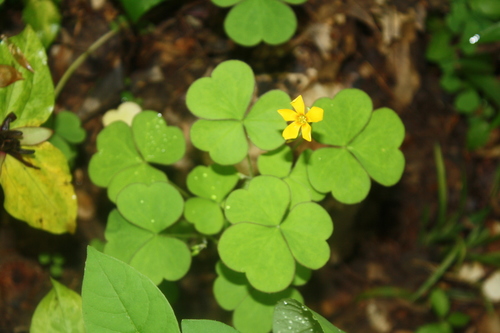
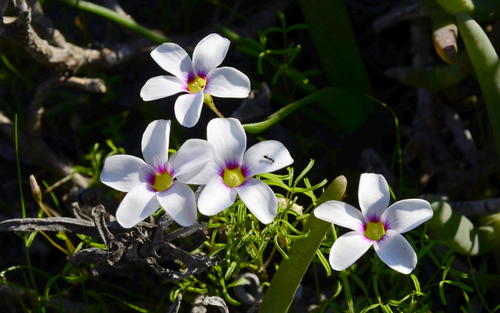
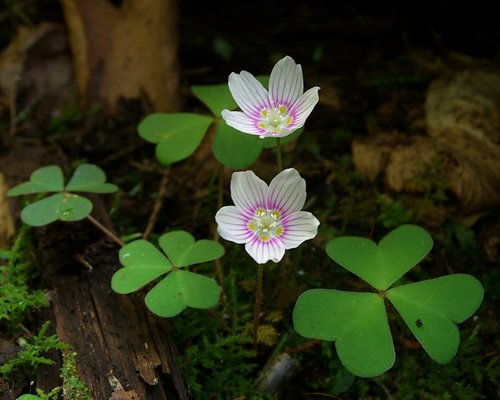
Oxalis montana Raf. is a perennial herb that grows in patches connected by underground rhizomes. It produces no aboveground stems; instead, it forms clumps of leaves that reach a maximum height of about 10 centimeters (3.9 inches). Each leaf is made up of three heart-shaped leaflets, which fold and unfold in response to changes in sunlight. This species produces two types of flowers: open blooms that can be pollinated, and closed cleistogamous flowers that self-pollinate without opening. Flower color varies, with environmental factors driving this variation: flowers growing at higher elevations have less color in their petal veins, while flowers at lower elevations have deeper pink-purple veins. The fruit of Oxalis montana is a capsule. The plant reproduces both sexually via seed and asexually by sprouting large colonies from its rhizome. Some populations do not produce flowers in a given year, and reproduce only through vegetative growth. In terms of ecology, Oxalis montana is a climax species that grows in mature forests and tolerates shade. It is a dominant herb in multiple ecosystems, including the forests of the Appalachian Mountains, where it grows in the understory of red spruce (Picea rubens) and balsam or Fraser fir (Abies balsamea or A. fraseri). It is also dominant in northern hardwood forest habitat and their ecotones, growing in the understory of red or sugar maple (Acer rubrum or A. saccharum), yellow birch (Betula lutea), and American beech (Fagus grandifolia). Other dominant understory species that grow alongside Oxalis montana include false lily-of-the-valley (Maianthemum canadense), goldthread (Coptis groenlandica), starflower (Trientalis borealis), and woodferns (Dryopteris spp.). The plant's extensive root network helps stabilize soil. It can grow on both flat ground and steep slopes, in locations that typically have a cool, moist climate with high humidity, high precipitation including fog drip, and long-lasting snowpack, where wildfire is uncommon. For uses, Oxalis montana has a sour flavor and can be added to soups or salads. It contains oxalic acid, which can be poisonous when consumed in large quantities.