About Oxalis corniculata L.
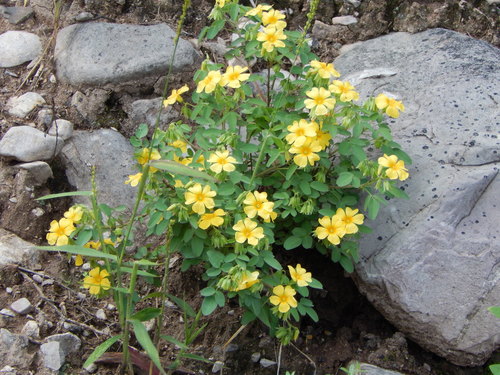
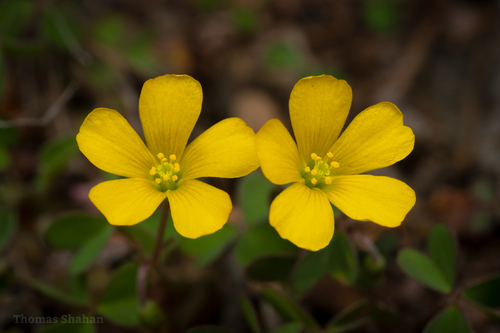
This species, Oxalis corniculata L., has a narrow, creeping stem that roots easily at its nodes. Its trifoliate leaves are split into three rounded leaflets, giving them a clover-like appearance. Some varieties grow green leaves, while others such as Oxalis corniculata var. atropurpurea have purple leaves. Inconspicuous stipules sit at the base of each petiole. Its small yellow flowers have petals that can be either round-edged or sharp-ended. Flowers close when the plant is not in direct sunlight, giving it the common name "sleeping beauty". Individual specimens can bear anywhere from one single flower to over 20 flowers. The fruit is a narrow, cylindrical capsule 1–2 cm (0.4–0.8 in) long, and is well known for explosively discharging its contained 1 mm (0.04 in) long seeds. The pollen of this species is around 34 microns in diameter. This species most likely originates from southeastern Asia. It was first formally described by Linnaeus in 1753 from specimens collected in Italy, and appears to have been introduced to Italy from the east before 1500. It now has a cosmopolitan distribution, and is often considered a weed in gardens, agricultural fields, and lawns. The leaves of this species are edible, with a tangy taste similar to lemons. A drink can be made by steeping the leaves in hot water for about 10 minutes, sweetening, then chilling the finished infusion. The entire plant is rich in vitamin C. Any woodsorrel is safe when consumed in low dosages, but eating large quantities over a long period can inhibit the body's calcium absorption. Indigenous peoples of Taiwan frequently grow this plant, known roughly as p-r-səʔ, as a treatment for snakebites and scabies.