About Ovis aries Linnaeus, 1758
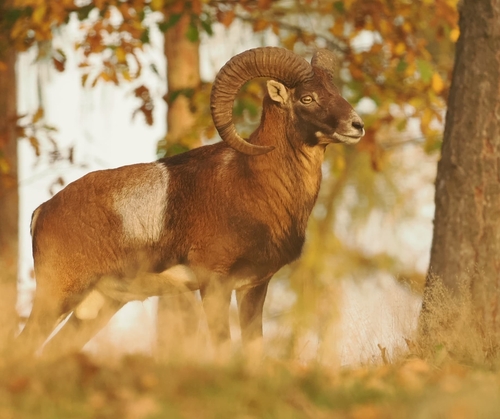
Domestic sheep (Ovis aries Linnaeus, 1758) are relatively small ruminants, usually with crimped hair called wool and often with horns that form a lateral spiral. As a result of human selective breeding, they differ from their wild relatives and ancestors in several ways, most notably that they are uniquely neotenic. A small number of primitive sheep breeds retain some wild ancestor traits, such as short tails. Horn presence varies by breed: domestic sheep may be completely polled (hornless), have horns in both sexes, or have horns only in males. Most horned breeds have one pair of horns, but a few breeds may have multiple pairs. Compared to wild ovines, another unique trait of domestic sheep is their wide range of color variation. Wild sheep mostly only have different shades of brown, with very limited color variation within the species. Domestic sheep can range in color from pure white to dark chocolate brown, and may even be spotted or piebald. Sheep keepers sometimes artificially apply identification markings called smit marks in any pattern or color to sheep. Selection for white fleeces that dye easily began early in sheep domestication, and since white wool is a dominant trait, it spread quickly. Even so, colored sheep still appear in many modern breeds, and can even show up as a recessive trait within white flocks. While white wool is preferred for large commercial markets, there is a smaller niche market for colored fleeces, mostly used for handspinning. Fleece texture and structure varies widely between breeds, ranging from dense and highly crimped to long and hairlike. Wool type and quality can even vary between individual sheep in the same flock, so wool classing is a required step in commercial processing of the fibre. Mature heights and weights of sheep vary by breed. Growth rate and mature weight are heritable traits that are often targeted for selection in breeding. Ewes typically weigh between 45 and 100 kilograms (100 and 220 lb), while rams weigh between 45 and 160 kilograms (100 and 350 lb). After all deciduous teeth have erupted, a sheep has 20 teeth, while mature sheep have 32 teeth. Like other ruminants, the front teeth on the lower jaw bite against a hard, toothless pad on the upper jaw. These front teeth are used to pick off vegetation, and the rear teeth then grind the vegetation before it is swallowed. Ruminants have eight lower front teeth, but there is disagreement over whether these are all eight incisors, or six incisors plus two canines shaped like incisors. This means the dental formula for sheep is either 0.0.3.3 4.0.3.3 or 0.0.3.3 3.1.3.3. There is a large gap (diastema) between the incisors and the molars. In a sheep's first few years of life, age can be estimated from the front teeth: one pair of milk teeth is replaced by larger adult teeth each year, and a full set of eight adult front teeth is fully grown in by around four years of age. As sheep age beyond four years, their front teeth gradually wear down and are lost, which makes feeding harder and harms the animal's health and productivity. For this reason, domestic sheep on normal pasture begin to slowly decline in health and productivity starting at four years old. The average life expectancy of a sheep is 10 to 12 years, though some sheep can live as long as 20 years. Sheep have good hearing, and are sensitive to noise when being handled. They have horizontal slit-shaped pupils, with excellent peripheral vision; their visual fields cover around 270° to 320°, allowing them to see behind themselves without turning their heads. Many breeds have only short hair on the face, and some breeds only have facial wool (if any) limited to the poll and/or the area around the mandibular angle; the wide peripheral vision range applies to these breeds. A small number of breeds tend to grow a large amount of wool on the face; for some individuals of these breeds, peripheral vision may be greatly reduced by a condition called "wool blindness", unless the wool around the face has recently been shorn. Sheep have poor depth perception, and shadows or dips in the ground can cause sheep to stop and refuse to move forward. In general, sheep tend to move from dark areas into well-lit areas, and prefer to move uphill when disturbed. Sheep also have an excellent sense of smell, and like all species in their genus, have scent glands located just in front of the eyes, and between the toes on their feet. The function of these glands is not confirmed, but the facial glands may be involved in breeding behaviors. The foot glands may also be linked to reproduction, but other possible functions have been proposed, including secreting waste product, or producing a scent marker to help lost sheep rejoin their flock. Sheep follow a similar reproductive strategy to other herd animals. A group of ewes is generally mated by a single ram, who has either been selected by a breeder, or (in feral populations) has established dominance through physical competition with other rams. Most sheep are seasonal breeders, though some are able to breed year-round. Ewes generally reach sexual maturity at six to eight months old, and rams generally reach sexual maturity at four to six months old. There are exceptions to this, however: for example, Finnsheep ewe lambs may reach puberty as early as 3 to 4 months, while Merino ewes sometimes reach puberty at 18 to 20 months. Ewes have estrus cycles approximately every 17 days; during estrus, they emit a scent and display physical behaviors toward rams to signal they are ready to mate. In feral sheep, rams fight during the rut to determine which individuals get to mate with ewes. Rams, especially rams that are not familiar with one another, will also fight outside the breeding period to establish dominance; rams can kill one another if they are allowed to mix freely. During the rut, even normally friendly rams may become aggressive toward humans due to increased hormone levels. After mating, sheep have a gestation period of around five months, and normal labor takes one to three hours. While some breeds regularly produce larger litters of lambs, most sheep give birth to single or twin lambs. During or soon after labor, ewes and lambs may be kept in small pens called lambing jugs, which make it easier to closely observe the ewe and help strengthen the bond between the ewe and her lambs. Ovine obstetrics can be challenging. Over generations of selectively breeding ewes to produce multiple offspring with higher birth weights, sheep producers have accidentally caused some domestic sheep to experience difficulty during lambing; balancing easy lambing with high productivity is one of the persistent challenges in sheep breeding. If problems occur, people attending the lambing may assist the ewe by extracting or repositioning lambs. After birth, the ewe ideally breaks the amniotic sac (if it did not break during labor) and begins licking the lamb clean. Most lambs are able to stand within one hour of birth. In normal situations, lambs nurse after standing, to receive vital colostrum milk. Lambs that cannot nurse or are rejected by their ewe need human help to survive, such as bottle-feeding or fostering by another ewe. Most lambs are born outdoors. When lambs are several weeks old, lamb marking procedures are carried out: this includes ear tagging, tail docking, mulesing, and castration. Vaccinations are also usually administered at this time. Numbered ear tags are attached, or permanent ear marks are applied, to make it easier to identify individual sheep later. Docking and castration are commonly done after 24 hours (to avoid interfering with maternal bonding and the lamb's consumption of colostrum) and are usually completed no later than one week after birth, to minimize pain, stress, recovery time, and complications. The first round of vaccinations (most commonly anti-clostridial vaccines) is usually given at around 10 to 12 weeks of age, which is when the concentration of maternal antibodies passively received via colostrum is expected to have dropped low enough to allow the lamb to develop active immunity. Ewes are often revaccinated annually around 3 weeks before lambing, to provide high antibody concentrations in colostrum during the first several hours after lambing. Ram lambs that will either be slaughtered or separated from ewes before reaching sexual maturity are not usually castrated. Animal rights groups have raised objections to all of these procedures, but farmers defend them by stating that they reduce costs and only inflict temporary pain. Among mammals, sheep are the only species besides humans that exhibit exclusive homosexual behavior. Around 10% of rams refuse to mate with ewes but will readily mate with other rams, and thirty percent of all rams show at least some homosexual behavior. Additionally, a small number of female sheep that shared a uterus with a male fetus (as fraternal twins) are freemartins: female animals that have masculine behavior and lack functioning ovaries. Sheep meat and milk were one of the earliest staple protein sources consumed by human civilization after the shift from hunting and gathering to agriculture. Sheep meat prepared for consumption is called either mutton or lamb, and approximately 540 million sheep are slaughtered for meat each year worldwide. The word "mutton" comes from the Old French moton, the term for sheep used by the Anglo-Norman rulers who controlled much of the British Isles in the Middle Ages. This became the English name for sheep meat, while the Old English word sceap was retained to refer to the live animal. In modern usage, "mutton" refers specifically to meat from mature sheep, usually at least two years old; "lamb" refers to meat from immature sheep under one year old. In the 21st century, the countries with the highest per capita sheep meat consumption are the Arab states of the Persian Gulf, New Zealand, Australia, Greece, Uruguay, the United Kingdom and Ireland. In these countries, per capita sheep meat consumption ranges from 14–40 lbs (3–18 kg) per person per year. Sheep meat is also popular in France, Africa (especially the Arab world), the Caribbean, the rest of the Middle East, India, and parts of China. This popularity often aligns with a history of local sheep production. In these regions in particular, dishes that use less common cuts and offal are often popular or traditional. Sheep testicles, called animelles or lamb fries, are considered a delicacy in many parts of the world. Perhaps the most unusual sheep meat dish is Scottish haggis, made from various sheep innards cooked with oatmeal and chopped onions inside a sheep's stomach. By comparison, countries such as the United States consume less than one pound (under 0.5 kg) of sheep meat per capita per year; Americans eat 50 pounds (22 kg) of pork and 65 pounds (29 kg) of beef annually. In addition, these countries rarely eat mutton, and tend to favor more expensive cuts of lamb, mostly lamb chops and leg of lamb. Although sheep's milk is rarely consumed fresh today, it is primarily used to make cheese and yogurt. Sheep only have two teats, and produce a much smaller volume of milk than cows. However, sheep's milk contains far more fat, solids, and minerals than cow's milk, which makes it ideal for cheese-making. It also resists contamination during cooling better, due to its much higher calcium content. Well-known cheeses made from sheep milk include feta (from Bulgaria and Greece), Roquefort (from France), Manchego (from Spain), and pecorino romano and ricotta (from Italy; the Italian word for sheep is pecore). Yogurts, especially some types of strained yogurt, may also be made from sheep milk. Many of these products are now often made with cow's milk, particularly when produced outside their country of origin. Sheep milk contains 4.8% lactose, which may affect people who are lactose intolerant. As with other domestic animals, meat from uncastrated male sheep is lower in quality, especially as they mature. A "bucky" lamb is a lamb that was not castrated early enough, or was castrated incorrectly, leaving one testicle retained. These lambs have lower market value.