About Ovibos moschatus (Zimmermann, 1780)
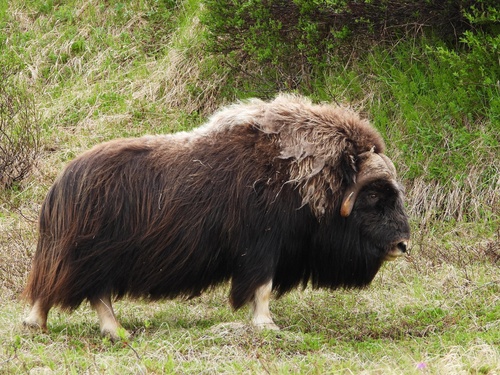
Both male and female muskoxen (Ovibos moschatus) have long, curved horns. They stand 1.1 to 1.5 meters (3 ft 7 in to 4 ft 11 in) high at the withers. Females measure 135 to 200 cm (4 ft 5 in to 6 ft 7 in) in total length, while larger males reach 200 to 250 cm (6 ft 7 in to 8 ft 2 in). Their small tail, often hidden under fur, is only 10 cm (3.9 in) long. On average, adult muskoxen weigh 285 kg (628 lb), with a total weight range of 180 to 410 kg (400 to 900 lb). Their thick coat and large head make them appear larger than they actually are; bison, which muskoxen are often compared to, can weigh up to twice as much. Heavily fed specimens kept in zoos have been recorded weighing up to 650 kg (1,430 lb). Their coat is a mix of black, gray, and brown, with long guard hairs that nearly reach the ground. Rare "white muskoxen" have been observed in the Queen Maud Gulf Bird Sanctuary. Muskoxen are occasionally semi-domesticated to produce wool, and rarely for meat and milk. The U.S. state of Alaska hosts several muskoxen farms specifically for wool harvesting. The wool, called qiviut, is highly valued for its softness, length, and insulating properties. A muskox can run at speeds of up to 60 km/h (37 mph), and their life expectancy ranges from 12 to 20 years. In modern times, the native range of muskoxen is limited to Arctic regions of Northern Canada, Greenland, and Alaska. The original Alaskan population was extirpated in the late 19th or early 20th century; this decline has been linked to excessive hunting, and may also have been contributed to by climate change. Muskoxen have since been reintroduced to Alaska. The United States Fish and Wildlife Service introduced muskoxen to Nunivak Island in 1935 to support local subsistence living. Additional reintroduced populations are now found in Arctic National Wildlife Refuge, Bering Land Bridge National Preserve, Ivvavik National Park in Yukon, a wildlife conservation center in Anchorage, Aulavik National Park in the Northwest Territories, Kanuti National Wildlife Refuge, Gates of the Arctic National Park, and a wildlife preserve in Whitehorse, Yukon. At least two separate domestication efforts have taken place. In the 1950s, a U.S. researcher and adventurer successfully captured muskox calves in Northern Canada to relocate them to a prepared property in Vermont. One condition set by the Canadian government was that he could not kill adult muskoxen defending their young. After nets and ropes proved ineffective, he and his crew herded family groups into open water, where calves were successfully separated from adults. The young animals were airfreighted to Montreal, then trucked to Vermont, where they acclimated to the temperate conditions. Though the calves survived and grew to adulthood, poor parasite and disease resistance reduced the overall success of the project. The remaining herd was eventually moved to a farm in Palmer, Alaska, where it has thrived since the mid-1950s. During summer, muskoxen occupy wet habitats such as river valleys, and move to higher elevations in winter to avoid deep snow. Their diet includes grasses, arctic willows, woody plants, lichens, and mosses. When food is plentiful, they prefer succulent, nutritious grasses. Willows are the most commonly consumed plant during winter. Muskoxen require a high threshold of fat reserves before they can conceive, a trait that reflects their conservative breeding strategy. Winter ranges typically have shallow snow, which reduces the energy cost of digging through snow to reach food. The primary predator of muskoxen is the arctic wolf, which may be responsible for up to half of all mortality for the species. Other occasional predators, which mostly target calves or weak adult muskoxen, include grizzly bears, polar bears, and wolverines. Muskoxen live in herds of 12 to 24 individuals in winter, and 8 to 20 in summer, when dominant bulls force other males out of the herd. They do not defend fixed territories, but they mark their travel trails using preorbital glands. Male and female muskoxen each have separate age-based social hierarchies, with mature muskoxen being dominant over juveniles. Dominant muskoxen tend to access the best resources, and will displace subordinate muskoxen from grass patches during winter. Muskox bulls use several different behaviors to assert dominance. One common behavior is the "rush and butt", where a dominant bull rushes a subordinate from the side with its horns, and gives the subordinate a warning to allow it a chance to retreat. Bulls also roar, swing their heads, and paw the ground to signal dominance. Dominant bulls sometimes interact with subordinate bulls in the same way they interact with cows: a dominant bull will tap a subordinate with its foreleg, a motion they also use with cows during mating. Dominant bulls will also perform mock copulation with subordinates and sniff their genitals. A subordinate bull can challenge a dominant bull's status by charging it. The mating (rutting) season for muskoxen begins in late June or early July. During this period, dominant bulls fight other bulls out of the herd and establish harems usually containing six or seven cows and their offspring. Before fighting, bulls will rub their preorbital glands against their legs while bellowing loudly, then display their horns. The bulls then back up around 20 meters (66 ft), lower their heads, and charge into one another, repeating this until one bull concedes. Subordinate and elderly bulls leave the main herd to form all-male bachelor groups or live alone. However, when threatened, these outside bulls can return to the main herd for protection. Dominant bulls prevent cows from leaving their harems. During mating, a bull will tap an estrous cow with his foreleg to calm her and make her more receptive to mating. The full herds reassemble once summer ends. While bulls are more aggressive during the rutting season and lead their groups during this time, females lead the herd during gestation. Pregnant females are aggressive and decide how far the herd travels each day and where the herd will bed for the night. Herds move more frequently when cows are lactating, to let cows access enough food to nurse their offspring. Cows have an eight- to nine-month gestation period, and calves are born between April and June. Cows do not give birth every year; if a winter is particularly severe, cows will not enter estrus and will not calve the following year. When giving birth, cows remain in the herd for protection. Muskox calves are precocial, and can keep up with the herd within a few hours of birth. Calves are accepted into the herd and nursed for the first two months. After two months, calves begin eating vegetation and only nurse occasionally. Cows communicate with their calves through braying. The bond between a calf and its mother weakens after two years. Muskoxen have a distinctive defensive behavior: when the herd is threatened, adult muskoxen face outward to form a stationary ring or semicircle around the calves. Bulls usually form the front line of defense against predators, with cows and juveniles gathered close behind them. Bulls determine the defensive formation during rutting, while cows make this decision during the rest of the year.