About Ovalipes catharus (White, 1843)
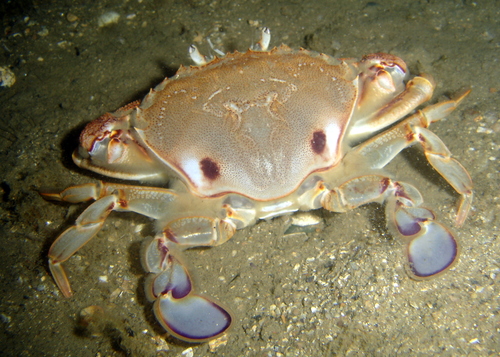
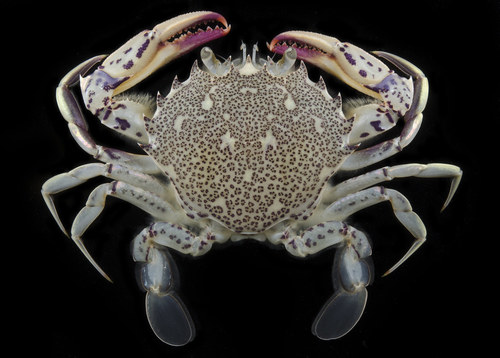
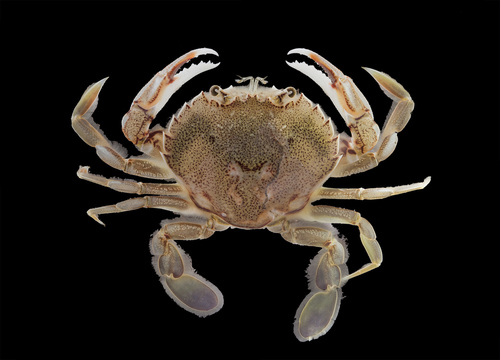
Ovalipes catharus, commonly known as the New Zealand paddle crab, has an oval, streamlined, slightly grainy carapace. Five large sawtooth-like projections sit on each side of its eyes, with four smaller projections at the front. The dorsal carapace has two large maroon eyespots at the rear, two smaller eyespots near the front, and cervical grooves that form a butterfly-shaped mark at the center. Its overall body color is sandy grey with orange-red highlights, dotted with small brown spots. The underside is white, and its flattened rear legs, which act as swimming paddles, have a purplish tinge. Unlike roughly half of all Ovalipes species, O. catharus has no iridescence on its body. The area above its mouth near the base of the antennae is somewhat hairy, and a line of setae runs from the base of its deep orbits out to the area under the carapace teeth. Like other Ovalipes species, it has well-developed, relatively large eyes.
Its relatively short front legs, the chelipeds, have spines and granules on the wrists and setae on the posterior border of the arms. The left minor pincer is smaller than the right major pincer, and both dactyli, the movable claw tips, are slender and tapered. In females, the minor chela grows in direct proportion to carapace width, while in males it may show proportionally slower, negatively allometric growth. The cutting minor chela is lined with small conical teeth on both fingers, and the crushing major chela also has a large proximal tooth. It has three pairs of somewhat granular, relatively flat walking legs, and the flattened rear swimming paddles are fringed with setae.
Mature male O. catharus can reach a maximum carapace width of 150 mm (5.9 in), with the largest males weighing 600–700 g (21–25 oz). Sexually mature females usually have a carapace width over 70 mm (2.8 in), and can grow to around 115 mm (4.5 in) wide. Abdomen growth follows direct proportionality to carapace width in males and juvenile females, but once a female reaches a carapace width of 30–40 mm (1.2–1.6 in), her abdomen shows positively allometric, proportionally faster growth. On average, the carapace is about 1.35 times as broad as it is long, and relative carapace length decreases compared to width as the crab grows.
The full lifespan of O. catharus is 3–5 years. It has a longer larval development period than most other decapods, lasting about two months with eight zoeal larval stages. During oogenesis, an oocyte buds off from an oogonium at an initial diameter of 5–25 μm, and grows to around 0.32 mm (0.013 in) as it develops. Newly laid eggs are nearly spherical, yellow, and approximately 0.3 mm (0.012 in) in diameter; after about one month, immediately before hatching into a zoea, eggs turn black and reach approximately 0.37 mm (0.015 in) in diameter. Zoea larvae are transparent or blackish, later develop red chromatophores, and turn black when they moult into the megalopal stage. Zoea have one prominent dorsal spine, one similarly prominent rostral spine, and two smaller lateral spines. In the megalopal form, the rostrum is much smaller relative to body size, and the 4.65 mm (0.18 in) long carapace is entirely smooth. After the megalopal stage, the paddle crab goes through 13 distinct developmental instar stages, and reaches maximum size at 3–4 years old. It is suspected that growth is only limited by the crab's lifespan, and that it would otherwise continue moulting once per year indefinitely. Isolated O. catharus populations from the Chatham Islands tend to grow larger and mature more slowly than populations from mainland New Zealand.
Ovalipes catharus is native to New Zealand, where it occurs from Stewart Island to Northland, and also lives in the Chatham Islands. It is also present but uncommon on the southern coast of Australia, found as far west as South Australia and as far east as Port Phillip Bay, Victoria. It inhabits sandy-bottomed coastal waters, generally at depths of less than 10 m (33 ft) in estuaries and the subtidal zone. During the day it typically buries itself in sediment, and moves into the intertidal zone to feed during the evening or night. The youngest juveniles usually live in shallow waters around 10–50 cm (4–20 in) deep, while the largest, most mature individuals are often found in deeper waters of 5–15 m (16–49 ft). Though it generally stays in shallow waters, it can be found at depths up to 100 m (330 ft), and its larvae can be found at depths of at least 700 m (2,300 ft). Juveniles typically occupy sheltered waters after migrating inshore during their megalopal stage. Males and females aggregate in sheltered bays during the winter and spring breeding season. After breeding, males move to large open beaches in spring, while females migrate to areas that have not yet been identified, speculated to be deeper spawning grounds for egg incubation. Anecdotal records indicate that the O. catharus population has increased substantially since the 1970s.
Ovalipes catharus undergoes a pubertal moult when it reaches a carapace width of about 50–60 mm (2.0–2.4 in), and reaches sexual maturity within the first year of benthic life. Males and females begin aggregating in shallow, sheltered bays during winter for mating, and breeding takes place from May to November, coinciding with the female's moult. Warmer temperatures extend the breeding season, speed up growth, and trigger earlier sexual maturity, leading to variation in mating timing between different populations. When male competition occurs near a receptive female, males become aggressive and communicate using sounds, though it is not known if these sounds are directed at females, competing males, or both. Males alternate between two distinct sounds: a multi-pulse, low-mid frequency "zip" sound created by rubbing ridges on the underside of the chelae against a plectrum-like joint on the first walking legs; and a series of sub-bass vibrations accompanied by periodic swaying, produced by an as-yet unknown internal mechanism. The zip sound is paired with what may be a courtship display, where the crab "walks forward and flicks both swimming paddles in a twisting motion."
A male can only mate with a soft-bodied female within a four-day window after her moult, so he carries a pre-moult female under his body for up to 10 days before mating. Even when hungry, males generally do not cannibalize a suitable female partner, and instead protect the female during mating, which lasts between 12 and 36 hours, and can last up to four days. After mating and separation, the male can still recognize his partner to avoid sexual cannibalism while her body remains soft, though cannibalism still sometimes occurs. Male protection of vulnerable newly moulted females is hypothesized to explain why sex ratios are skewed toward females in many O. catharus populations.
After mating, the male releases the female, who moves to likely deeper water spawning grounds. It is unknown how many egg batches can be fertilized from a single insemination, but females have been observed producing up to four or five batches without re-mating. The number of eggs per batch is strongly correlated with carapace width and body mass, with larger, heavier females producing more eggs. A single batch can contain anywhere from 80,000 to 850,000 eggs, and a large 100 mm (3.9 in) female typically produces around 500,000 eggs per batch. As with other crabs, a portion of eggs are lost to disease, developmental failure, and predation. Larvae develop synchronously and are generally released at night. They are released in large numbers when the female vigorously waves her body to disturb egg cases and prompt larvae to emerge. During release, the female extends her legs to position herself as far above the seafloor as possible, angles slightly upward, and flexes her abdomen to release large clouds of larvae. Females usually release all larvae at once, but in some locations they release larvae in multiple batches. The spawning season generally runs from September to March. Over a lifetime of four breeding seasons, a female O. catharus can produce up to an estimated 10 egg batches.