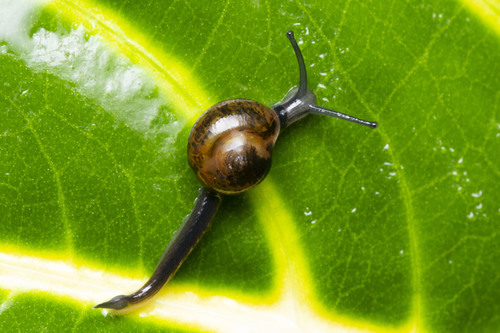
About Ovachlamys fulgens (Gude, 1900)
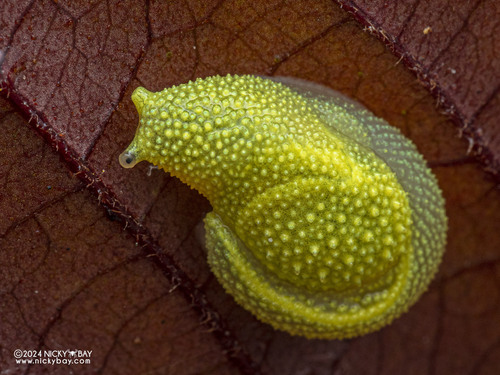
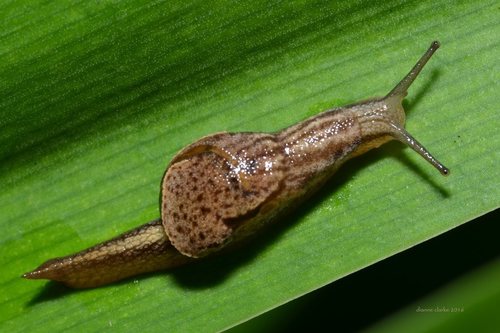
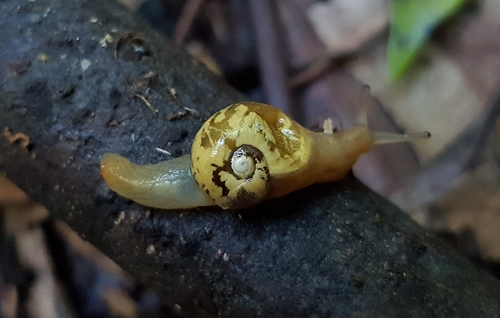
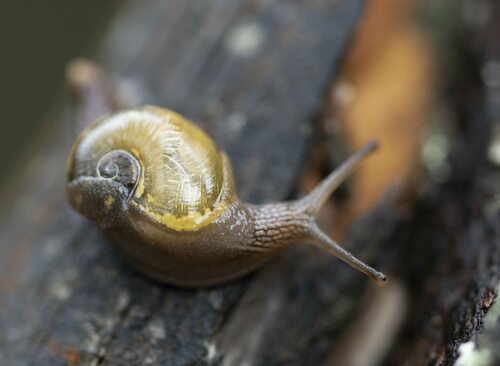
Ovachlamys fulgens (Gude, 1900) has a perforate, thin, shining, pellucid, dark corneous trochoid shell, with a depressed spire. The apex is obtuse, and the sutures are linear and margined. The shell holds four whorls that increase rather suddenly in size. The last whorl is convex and slightly inflated, reaching twice the width of the penultimate whorl. All whorls are finely striated, and decussated by microscopic spiral lines. The last whorl does not descend, and is slightly excavated in the umbilical region. The aperture is slightly oblique and lunate, with a thin, straight, acute peristome. The aperture margins are distant and sub-parallel; the columellar margin is slightly reflected, and nearly covers the very narrow umbilical perforation. The shell of this species measures 6–7 mm in width and 4.5 mm in height.
These snails are often called jumping snails, because their tail is modified with a caudal horn, and the posterior part of the foot acts as a catapult to push off from adjacent substrates, letting the snail move several inches suddenly. The type locality for this species is the Ryukyu Islands (also called Loo-Choo Islands), and it is thought to be originally native to this region. Its type specimens are stored in the Florida Museum of Natural History. Ovachlamys fulgens has spread to multiple countries, most likely accidentally introduced through the orchid trade. Non-indigenous populations of this species are found across the Americas: it occurs most frequently in Costa Rica; in the United States, it has been reported in Miami-Dade County, Florida and Broward County, Florida since 2003, and its wide distribution in sampled areas of southern Florida suggests it has already been established there for some time. It is also found in Trinidad and Tobago, Colombia, and Brazil (reported in Brazil since 2015). In the Pacific region, it is established in Hawaii. It is also found in several Southeast Asian countries, including Thailand and Singapore. This species is already established in the United States, where it is considered a potentially serious invasive pest that could harm agriculture, natural ecosystems, human health, or commerce. For this reason, it has been suggested that this species should be given top national quarantine significance in the USA.
Habitats for Ovachlamys fulgens include moist pastures and crop fields with deep leaf litter cover; for example, habitats with Yucca guatemalensis provide suitable conditions for this species. The snails are most often found in soil litter and on plants up to 8 feet in height in secondary growth areas and tree plantations. The ideal time to collect this species is after rainfall. This species is an important orchid pest. It is phytophagous, and reported to attack a wide range of horticultural plants. It is mostly found among soil litter, and becomes dormant during dry periods. It has been found growing on avocado, mango, Heliconia and Dracaena. Avocado leaves can also be used to raise juvenile snails of this species in laboratory settings. Little scientific data has been collected on the overall biology of this species. Individuals can begin laying eggs at 42 days of age, and are considered mature when their shell reaches 5.12 mm in width. This species does not require mating to lay eggs or reproduce successfully. Eggs are laid in clutches of three, in soil or leaf litter, where they absorb additional water from the surrounding environment. In laboratory settings, the lifespan of Ovachlamys fulgens is 9 months.