About Ourisia vulcanica L.B.Moore
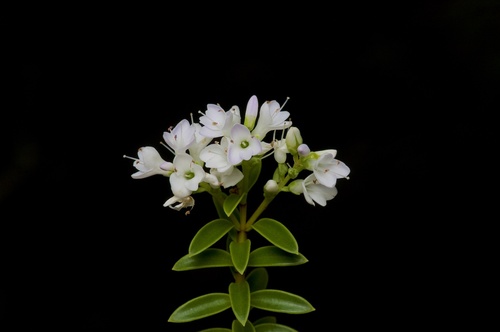
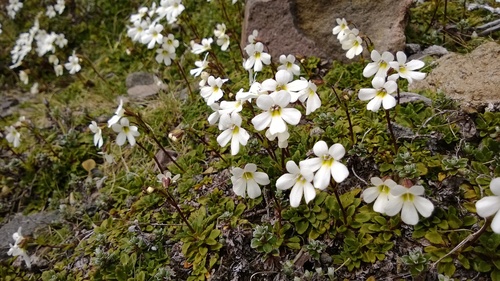
Ourisia vulcanica is a species of perennial herb. It has creeping horizontal stems, with tightly tufted opposite leaves arranged along the stem. Leaf petioles range from 3.0 to 22.0 mm in length. Leaf blades measure 6.9–26.8 mm long by 4.7–20.1 mm wide, giving a length-to-width ratio of 1.5–2.0:1. Blades are usually narrowly ovate to broadly ovate, most often widest below the middle, with a subacute apex, cuneate base, and crenate margins. Leaves are glabrous or have only a few non-glandular hairs on both surfaces, and are punctate on the lower surface. Its inflorescences are erect hairy racemes that grow up to 17.7 cm long, with 1 to 4 flowering nodes and up to 8 total flowers per raceme. Each flowering node holds up to 3 flowers, plus 2–3 sessile bracts that sometimes clasp the stem. These bracts are usually narrowly lanceolate to narrowly ovate, and are either glabrous or hairy with non-glandular hairs near their edges. The lowest bracts resemble the plant’s leaves, measuring 9.4–19.4 mm long and 3.4–9.4 mm wide, and bracts get smaller moving toward the apex of the raceme. Flowers are carried on densely hairy pedicels up to 25.4 mm long, which only bear non-glandular hairs. The calyx is 5.6–8.6 mm long and irregularly shaped: three of its lobes are split one-quarter to one-half of their length to the base, while the remaining two lobes are split nearly all the way to the base. The calyx has non-glandular hairs distributed sparsely to densely across its surface. The corolla is 11.7–15.6 mm long (this measurement includes the 5.4–9.4 mm long corolla tube). It is bilabiate and tubular-funnelform, usually glabrous or sometimes with a small number of non-glandular hairs near the base of the lobes. The outside of the corolla is white, sometimes flushed with red; the inside is yellow, marked with three lines, and has a ring of hairs. Corolla lobes are 4.0–8.2 mm long, spreading, and typically obovate-spathulate. There are 4 didynamous stamens, reaching up to 11.5 mm in total length: the two longer stamens are exserted or reach only to the corolla tube, while the two shorter stamens usually reach the opening of the corolla tube or are exserted. A short staminode around 0.5 mm long is also usually present. The style is 6.0–7.4 mm long, exserted, and ends in an emarginate stigma. The ovary is 2.5–4.0 mm long and glabrous. Fruits are capsules around 5.6 mm long and 4.2 mm wide, that open via loculicidal dehiscence, and are carried on pedicels that can grow up to 29.8 mm long. It is unknown how many seeds develop inside each capsule. Seeds are 0.7–0.9 mm long and 0.3–0.5 mm wide, with a two-layered, reticulate seed coat. Ourisia vulcanica flowers from October to May and fruits from December to May, and has a chromosome number of 2n=48. This species is endemic to the Volcanic Plateau area of the central North Island of New Zealand, including Tongariro National Park and the Kaimanawa Range. It typically grows at or above the bushline, in open or shaded subalpine or alpine rocky habitats. These habitats include tussock grassland or scrubland, on volcanic scoria, in both dry and damp sites, at elevations from 750 to 1,800 m (2,460 to 5,910 ft) above sea level. It can be locally abundant in its range.