About Ourebia ourebi (Zimmermann, 1783)
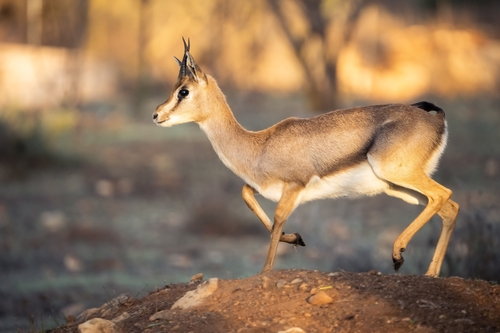
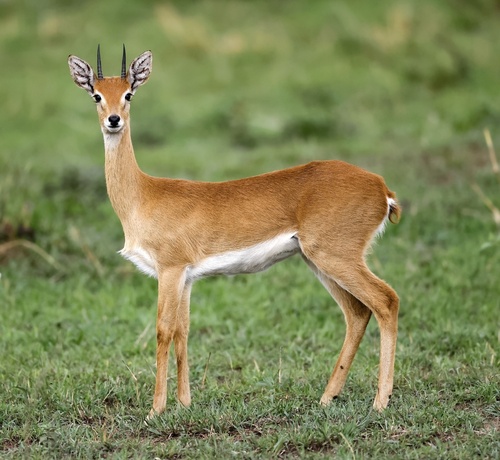
The oribi (Ourebia ourebi) is a small, slender antelope. Shoulder height ranges from 50 to 67 centimetres (20 to 26 inches), body mass is 12 to 22 kilograms (26 to 49 pounds), and head-and-body length is typically 92 to 110 centimetres (36 to 43 inches). The species is sexually dimorphic: males are slightly smaller than females, except for the subspecies O. o. ourebi, where females are smaller. Oribi have a slightly raised back, long neck, and long limbs. Their glossy coat ranges from yellowish to rufous brown, which contrasts sharply with the white chin, throat, underparts, and rump. Their bushy tail is brown to black on the outside and white on the inside; the only exception is O. o. hastata, which has a completely black tail. Subspecies vary in colouration: O. o. ourebi is a rich rufous, while O. o. hastata is yellower. Only males have horns; these thin, straight horns measure 8 to 18 centimetres (3.1 to 7.1 inches) long, are smooth at the tips and ringed at the base. The maximum recorded horn length is 19.1 centimetres (7.5 inches), recorded from Malawi in 1998. Oribi have at least six distinct, well-developed scent glands, including prominent preorbital glands near the eyes. Large fossae below the eyes are a bodily modification that accommodates this large number of glands. Females have four teats. Oribi occur across a variety of habitats, including savannahs, floodplains, tropical grasslands with grasses 10 to 100 centimetres (3.9 to 39.4 inches) tall, and montane grasslands from low altitudes up to 2,000 metres (6,600 feet) above sea level. Groups of oribi are often attracted to recently burned areas. Habitat choice depends on the availability of cover to hide from predators. Population density typically ranges from 2 to 10 individuals per square kilometre, but densities as high as 45 individuals per square kilometre have been recorded in tropical grasslands with over 110 centimetres (43 inches) of annual rainfall and on open floodplains. The oribi's range overlaps with the ranges of larger grazers including African buffalo, hippopotamus, hartebeest, Thomson's gazelle, and topi. These separate species often occur close to one another, which improves predator vigilance. Oribi have a highly sporadic distribution. They are found mainly in eastern, southern, and western Africa, ranging from Nigeria and Senegal in the west to Ethiopia and Eritrea in the east, and extending south to Angola and the Eastern Cape of South Africa. The species is feared to be extinct in Burundi. Oribi are diurnal, meaning they are active mainly during the day, though some activity can also occur at night. They rest in cover during rain events. Unlike other small antelopes, oribi can display three different mating systems depending on their habitat: polyandry, polygyny, and polygynandry. Polygyny becomes more common as the female-to-male ratio increases. Research suggests polygyny is preferred in areas with high predator risk, because it leads to group formation as an anti-predator adaptation. Small herds of up to four members are also common. Males defend their group's territory, which is 25 to 100 hectares (62 to 247 acres) in size; female group members may also show aggression to drive away intruders. One study found that the number of females that visit a male's territory depends on the appearance, particularly symmetry, of the male's horns. Males mark vegetation and soil in their territories using preorbital gland secretions and excrement; marking intensity increases when there are more neighbouring males. Dominant males typically have greater access to females in and around the territory than other males. A key feature of oribi social behaviour is the "dung ceremony", where all individuals in a group create temporary shared dung middens. Oribi that are at least three months old have been observed sounding one to three alarm whistles when they detect danger. These whistles are more common in adults than juveniles, and males whistle more often than females. Common predators of oribi include carnivorans such as jackals. Both sexes reach sexual maturity at 10 to 14 months old. Oribi are seasonal breeders, and the timing of mating varies by geographic location. Mating often peaks in the rainy season, from August to September. When a female enters oestrus, which lasts four to six days, she seeks out males. During courtship, the male pursues the female, tests her urine to check if she is in oestrus, and licks her rump and flanks. Gestation lasts six to seven months, after which a single calf is born. In southern Africa, births peak from November to December. Newborn calves stay hidden for almost a month; the mother visits regularly to nurse, for nearly half an hour each visit. Males may guard their offspring from predators and keep other males away. Calves are weaned at four to five months old. Oribi live 8 to 12 years in the wild, and 12 to 14 years in captivity.