About Oulophyllia crispa (Lamarck, 1816)
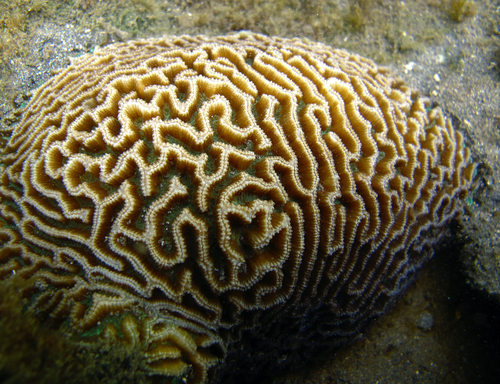
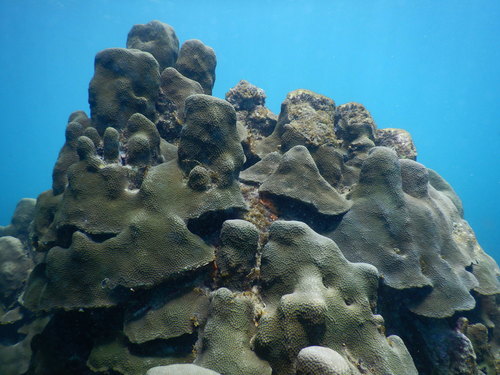
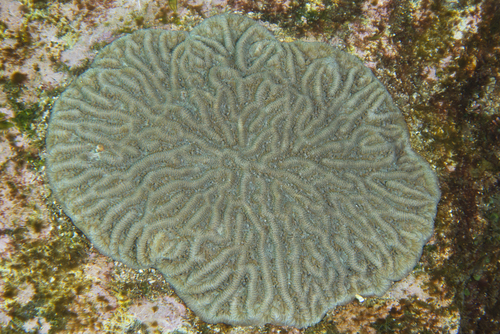
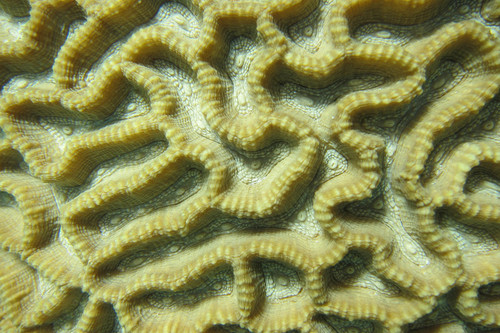
Colonies of Oulophyllia crispa form massive hemispherical domes, stacks, or plates that can reach one metre (one yard) or more across. However, in the Red Sea, this species seldom exceeds 20 centimetres (8 inches) across. Its corallites are arranged in broad meandering valleys, separated by ridges with acute edges. The septa are thin, evenly spaced, and slope uniformly toward the central columella. The large, fleshy polyps only expand at night, and they have tentacles with white tips. This coral is usually some shade of brown, grey, or green, and sometimes has contrasting oral discs. It is somewhat similar in appearance to Platygyra daedalea. This coral occurs in the tropical western and central Indo-Pacific region. Its range extends from the Red Sea, Gulf of Aden, and East Africa to Australia, Japan, the East China Sea, and the island groups of the West Pacific Ocean. It inhabits reefs at depths down to approximately 30 metres (100 feet), and is mostly found on subtidal rocks and in lagoons. Oulophyllia crispa is a zooxanthellate coral, with unicellular dinoflagellates embedded in its soft, transparent tissues. These symbionts use sunlight to produce organic carbon molecules that the coral can utilize. As this coral grows, its polyps do not divide completely, which leaves several mouths present in each large corallite. Boring sponges of the genus Cliona, polychaete worms, and bivalve molluscs bore holes into colonies of this coral, causing bioerosion.