About Oulema melanopus (Linnaeus, 1761)
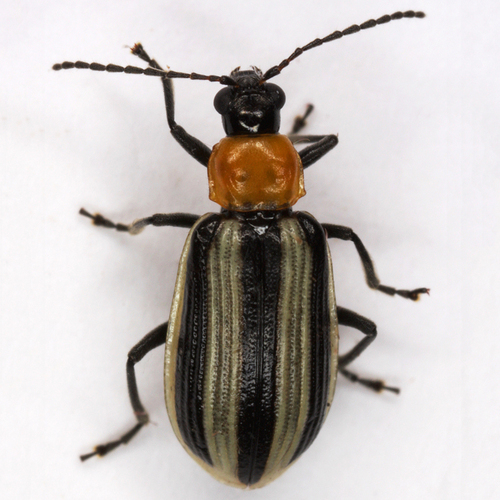
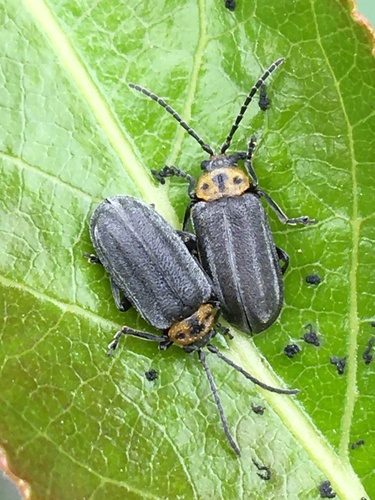
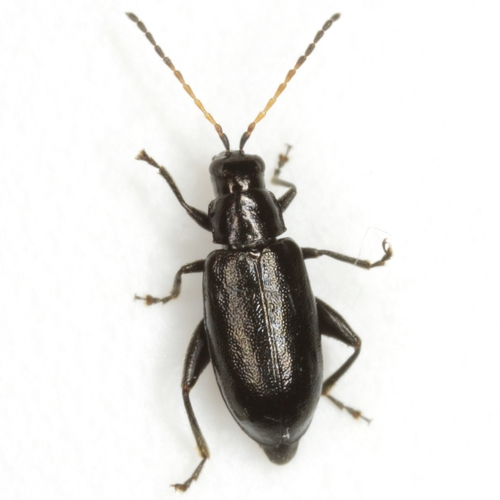
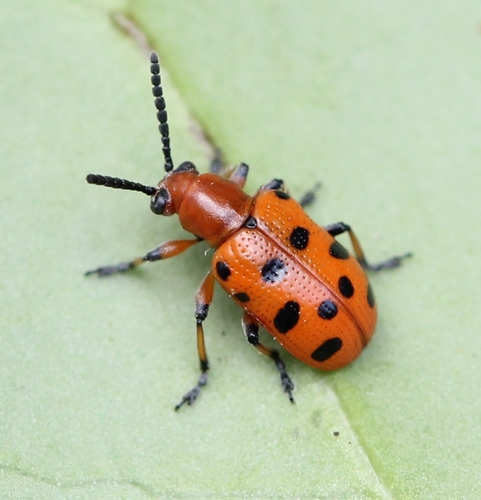
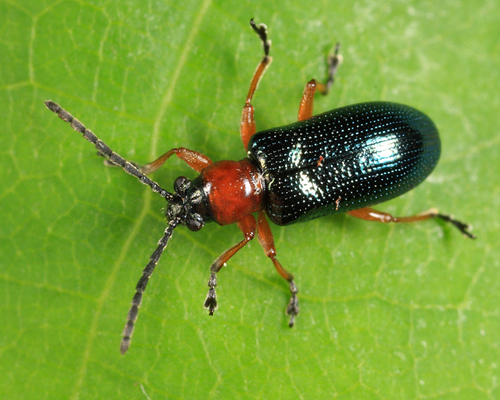
The cereal leaf beetle, with the scientific name Oulema melanopus, is a major crop pest that was formally described by Carl Linnaeus in 1761. This species is native to Europe and Asia, and it has since spread to become widespread across the globe. It was first recorded in North America in Berrien County, Michigan, in 1962. After this initial detection, it spread across the Midwestern United States to the East Coast, and continues to expand its range westward. Significant established populations are currently found in Virginia, North Carolina, Utah, Montana, North Dakota, Missouri, and Iowa. Annual O. melanopus population levels are strongly affected by environmental conditions including temperature and humidity. A cold spring benefits the beetle's host plants, while a warm spring benefits the cereal leaf beetle itself. Rising global temperatures may allow the species to spread further into Canada. Recent survey data confirms O. melanopus has already established in Canada: in 2006, the species was present in 11.1% of surveyed fields in southern Alberta, and this rose to 33.3% of fields by 2009. During overwintering, adult beetles spread to the edges of fields locally. Larvae are most often found on the edges of crop fields, but can also occur in field centers. Local populations never have a homogeneous distribution, with dense hotspots and unoccupied areas present within every single field. O. melanopus feeds on nearly all cereal crops, with a strong preference for oats, barley, and rye, and wheat is its favored host plant. Alternative food sources include corn, sorghum, and sudangrass for adult beetles, while all life stages can feed on wild oats, quackgrass, timothy, canary grass, reed canary grass, annual and perennial ryegrass, foxtail, orchard grass, wild rye, smooth brome, and fescues. Feeding by O. melanopus leaves characteristic thin, long lines on plant leaves where the upper leaf epidermis has been consumed. Since the beetles move as they feed, damage is not uniform across a field. In Michigan, entire fields are rarely affected, and this pattern is likely consistent across the Midwest. Infested fields look weathered and stunted, but are never completely destroyed, and total damage usually does not exceed 40% of crop yield or tissue. When plants are consumed by herbivores, they release volatile organic compounds (VOCs), which act as chemical signals that attract certain predators of the beetle. Female O. melanopus avoid areas with these VOCs to protect themselves and their offspring. Males are also deterred by the compounds, but do not alter their feeding behavior. Scientists have conducted experiments to study the feeding habits of O. melanopus using different media, testing agar gel infused with pea and barley extracts to record the beetles' reaction. When tested alone, pea extract (an undesirable food for the beetles) and barley extract (an alternative food source) both slowed or stopped consumption. However, a combination of both extracts triggered a weak feeding response. This suggests a secondary compound in barley prompts feeding, likely when preferred food sources are scarce.