About Oulactis muscosa (Drayton, 1846)
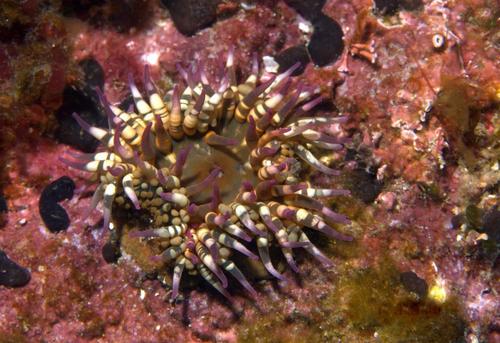
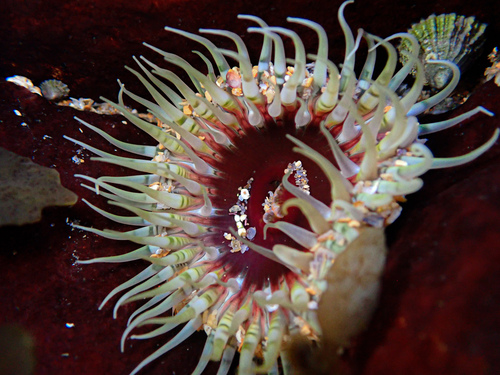
Oulactis muscosa is a large sea anemone species that grows to between 60 and 80 millimetres in size. Its base body colour ranges from greenish-grey to off-white. It can have up to one hundred short, conical tentacles arranged in three rows; tentacle colour varies from transparent to pale greenish, greyish-white, or pale brown, and the tentacles feature horizontal black bands. The column has vertical rows of adhesive bumps called verrucae, which are noticeably darker than the rest of the body. The oral disk shows variable colouration, and may be red, green, black, or white, sometimes with darker-coloured streaks that radiate outwards from the mouth. A key identifying feature of this species is the gravel, shell fragments, or coarse sand it attaches between its tentacles.
Oulactis muscosa is closely related to Oulactis mcmurrichi, commonly called the southern sand anemone. The two species share the same distribution and habitat, and can be told apart by differences in colouration: Oulactis mcmurrichi has a column that is typically reddish-brown, green, or light purple, and has light green tentacles. It has been suggested that the two may actually be variants of the same single species.
This anemone is distributed in New Zealand, and in Australian waters off southern Queensland, New South Wales, Victoria, Tasmania, and South Australia. It inhabits rocky areas of the mid to low intertidal zone, living within sand that has settled into rock cracks and crevices. Usually, only its oral disc and tentacles are visible above the substrate.