About Otus bakkamoena Pennant, 1769
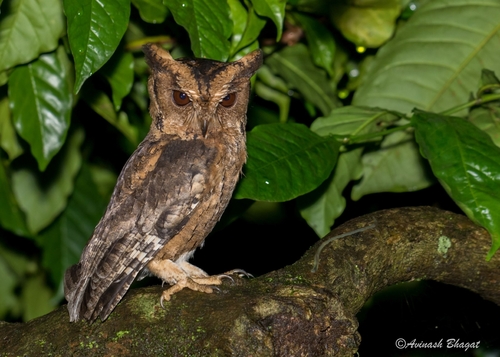
The Indian scops owl (scientific name Otus bakkamoena Pennant, 1769) is a small owl that measures 23–25 cm (9.1–9.8 in) in length, and it is one of the largest species among scops owls. Like other scops owls, it has small head tufts, also called ears. Its upperparts are either grey or brown, depending on the individual's morph, and marked with faint buff spotting. Its underparts are buff with fine darker streaking. It has a whitish or buff facial disc, orange or brown eyes, and a buff neckband. Males and females are similar in appearance. Its flight pattern is deeply undulating. This species is very similar to the slightly larger, partially migratory collared scops owl (Otus lettia) and the oriental scops owl (Otus sunia); the three can be distinguished from each other by their calls and eye colours. This species is distributed from eastern Arabia through most of the Indian subcontinent, excluding the far northern part of the region. The Indian scops owl is nocturnal. Thanks to its natural camouflage, it is very difficult to spot during the day. However, it can sometimes be located by small birds that mob it while it roosts in a tree. It feeds mainly on insects. Its call is a soft single note, described as "whuk?". It nests in tree cavities and lays 3 to 5 eggs per clutch.