About Ototylomys phyllotis Merriam, 1901
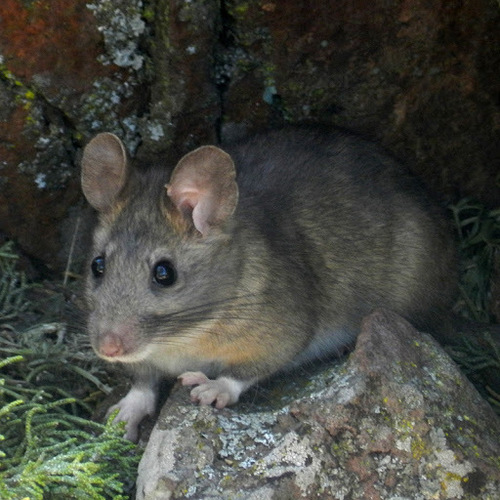
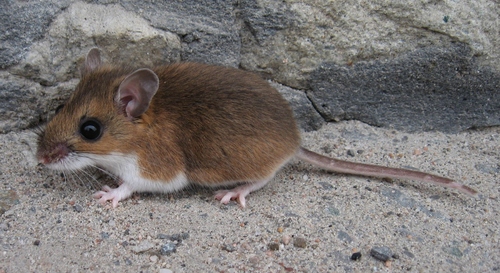
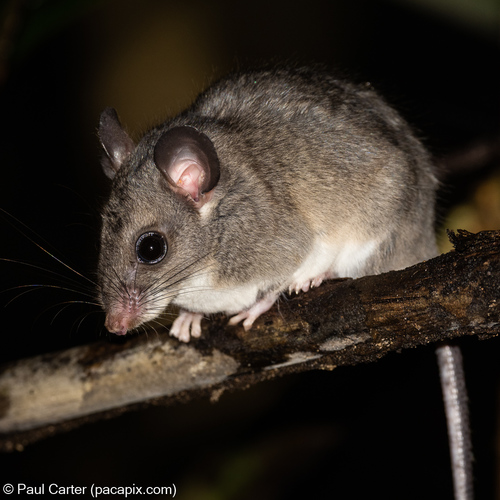
This species, commonly called the big-eared climbing rat, has the scientific name Ototylomys phyllotis Merriam, 1901. It belongs to the order Rodentia and the family Cricetidae, and it is the most widely distributed species in the genus Ototylomys. A second species in this genus was described in 2017, from the Mexican state of Chiapas. The genus Ototylomys originated 3.35 million years ago, before the Great American Biotic Interchange, and the genus first appeared near Honduras and El Salvador. The genus name Ototylomys comes from Greek words: otus meaning ear, tylos meaning knob, knot, or swelling, and mus meaning mouse. This name refers to the species’ large ears and shelf-like skull. The big-eared climbing rat is a slender rat with two-toned coloration: dark fur on the upper part of its body and lighter fur on the underside. It has large eyes and large, hairless ears. It also has a long, hairless, scaled tail. The species’ size and color vary across its geographic range. Most populations have a creamy white underbelly, but populations in Mexico and Guatemala have a slate-colored underbelly. The top of this species’ skull is flat, and it has a prominent interparietal bone and supraorbital ridges. There is no sexual dimorphism in this species. This species has a distribution ranging from Mexico to Costa Rica.