About Otolemur garnettii (Ogilby, 1838)
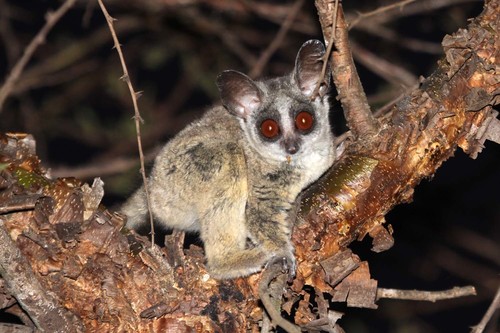
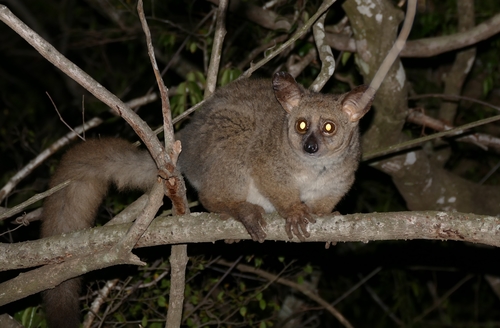
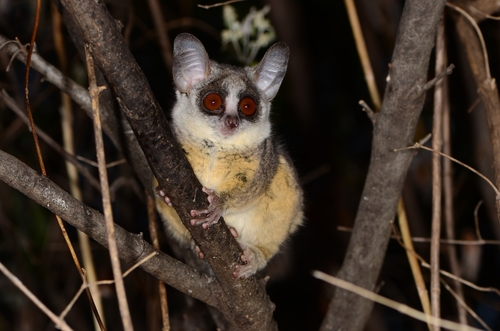
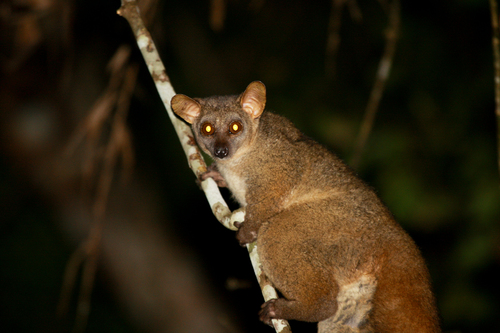
Otolemur garnettii, commonly called the northern greater galago, is larger in body size than other galagos. Compared to its round head with a short, wide snout, its ears are small. It has large, binocular eyes, and its dental formula is 2:1:3:3. Pelage coloration varies by subspecies. O. g. garnettii has green-tinged reddish brown fur on its dorsal side, yellow fur on its ventral side, and black fur on the terminal half of its tail. O. g. lasiotis has lighter, grayer fur than O. g. garnettii, white ventral fur, a tail tip that is only slightly darker than the rest of the tail, and a white tail tip. O. g. kikuyuensis has iron gray fur with green tinge on its back, flanks, and limbs, yellow-white ventral fur, and a typically light brown tail with a black terminal quarter. O. g. panganiensis has fur ranging from reddish brown to gray that lacks the greenish tinge seen in other subspecies, ventral fur that ranges from white to yellow, and a dark brown or black terminal quarter of the tail. Northern greater galagos have a head-and-body length of 23 to 34 centimeters, with an average of 26 centimeters, a tail length of 31 to 44 centimeters, with an average of 36 centimeters, and a body weight of 0.5 to 1 kilogram, with a mean of 0.75 kilograms. This species shows significant sexual size dimorphism, with males larger than females. This difference comes from bimaturism: males have a longer growth period, and their average body mass is 19% greater than that of females. The average adult male weighs 794 grams, while the average adult female weighs 734 grams. In galago species, males have very distinctive penile morphology that can be used to classify species. For the northern greater galago, the average penis length is 18 millimeters, and the shaft has an even width from the body to the base of the tip. The baculum is clearly visible at the tip, and the glans ends in a characteristic set of curves not found in any other species. The penile surface is covered in spines, which are double-headed or even tridentate and point toward the body. These spines are less densely packed than those of Otolemur crassicaudatus. Northern greater galagos are promiscuous. Females enter estrus once per year in the spring. Males are attracted to females in heat and produce a sex call. If the female is receptive, she allows copulation, after which the male licks her head. This process may be repeated. The gestation period for this species is 13130 days, and females typically give birth to only one offspring at a time; twins are rare. Mothers carry their infants in their mouths to nests, leave the infants there while they forage, and return to nurse. Infants are weaned by the 5th week and reach sexual maturity by 20 months of age. This species is found in coastal East Africa, ranging from the Juba River in Somalia to the Ruvuma River in Tanzania. It also occurs inland throughout the Kenyan highlands, and on the islands of Zanzibar and Pemba. It is restricted to coastal and riverine forests, or Kenyan highland forest, and does not live in woodland savannah. Each subspecies has its own specific geographic range. O. g. garnettii is limited to Zanzibar and the Pemba Islands. O. g. lasiotis occurs along the Kenyan coast as far north as the Juba River and south to the Tanga Region of Tanzania, and its range extends inland to the Taita Hills and Kibwezi. O. g. kikuyuensis is found in the Kenyan Highlands. O. g. panganiensis occurs throughout Tanzania, from the Mozambique border north to Tanga.