About Otolemur crassicaudatus (É.Geoffroy Saint-Hilaire, 1812)
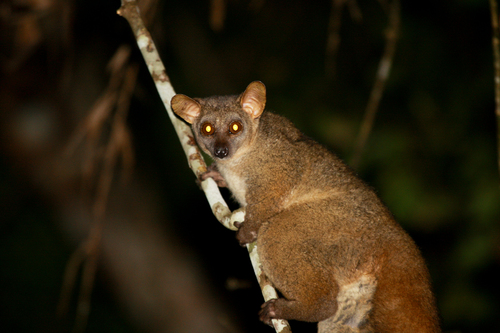
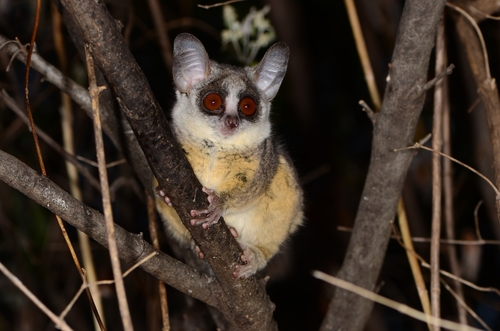
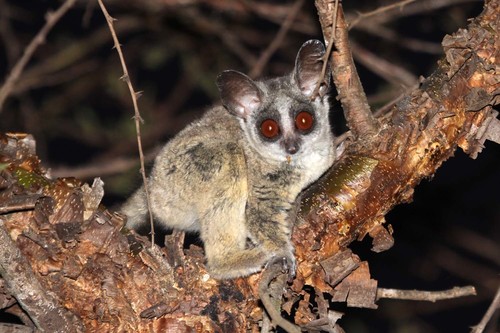
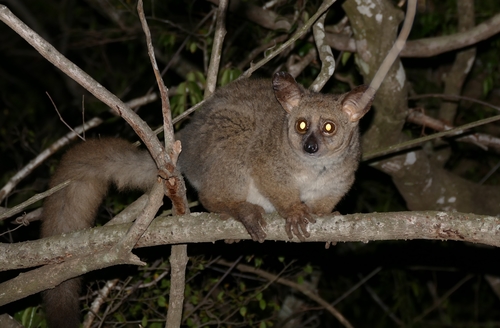
Otolemur crassicaudatus, commonly known as the brown greater galago, has a rounded head with a short, wide snout, very large ears that can move independently, and relatively large forward-facing binocular eyes. At the ends of its fingers and toes, it has flat, thickened skin pads to help grasp tree limbs. Its fingers are long, and its toes are flattened with flattened nails. The species has a dental formula of I 2/2, C 1/1, P 3/3, M 3/3.
Its thick fur varies greatly in color between the two recognized subspecies. For the nominate subspecies O. c. crassicaudatus, the upper (dorsal) fur ranges from buff to gray, and this color extends across the face, flanks, and limbs; the lower (ventral) fur is cream-colored, the tail has a darker tip, and the hands and feet are darkened except on the digits. For O. c. kirkii, dorsal fur ranges from brown to gray, ventral fur is cream to yellow, the tail is usually light brown, and the hands and feet do not have the darkening pattern seen in the nominate subspecies.
The brown greater galago has a head-and-body length of 26 to 47 centimeters (average 32 cm), a tail length of 29 to 55 centimeters, and a body weight of 0.5 to 2 kilograms. This species shows sexual size dimorphism, with males larger than females. This size difference comes from bimaturism: males grow for a longer period (an average of 84.5 more days) than females, even though both sexes grow at the same rate. As a result, males have an average of 16% more body mass than females: females average 1.2 kg (2.6 lb), while males average 1.5 kg (3.3 lb).
Among galago species, males have very distinctive penile anatomy that can be used to tell species apart. In O. crassicaudatus, the penis averages 20 mm (0.79 in) long and grows wider toward the distal tip. The baculum clearly protrudes from the end of the penis, and both the glans and shaft are covered in single keratinized penile spines that point toward the body.
Mating season occurs in June, and females enter estrus for approximately two weeks. Females use an advertising call to signal they are receptive to mating. Males approach and copulate repeatedly with females, maintaining intromission for several hours. Mating patterns can be either monogamous or polygynous, and this is usually determined by overlapping home ranges and male competition for high-quality territories.
Females typically give birth to 2 young, though litters of 1 or 3 also occur. The average gestation period is 133 days. Females usually reach sexual maturity by 2 years of age, while males usually reach reproductive maturity later than females due to size-related competition between males. After giving birth, the mother leaves her young to forage and returns to nurse them with nutrient-rich milk. Juveniles typically stay with their mother until they are close to reaching sexual maturity.
This species is common in Southern and East Africa, with the largest populations found in Angola, Tanzania, Rwanda, southern Kenya, and the coast of Somalia. The brown greater galago inhabits tropical and subtropical forest, and prefers riverine and coastal forest, though it can also be found in woodland savannah. The two subspecies have separate ranges: the nominate O. c. crassicaudatus is found only in the KwaZulu-Natal region, while O. c. kirkii is found from Massangena north to Vila Coutinho, in Mozambique and Malawi.